
The organization that Paul Allen founded to map and understand the complexities of the human brain is now looking to turn that hard-won knowledge into treatments for brain disease.
The Allen Institute is announcing Tuesday that it’s launching a new initiative with $200 million in initial funding and the ultimate goal of developing gene therapies for neurodegenerative diseases such as Alzheimer’s, Parkinson’s, Huntington’s, and ALS.
The initiative, called the Brain Health Accelerator, is a newly created unit within the Seattle-based Allen Institute, formed out of its existing Brain Science division. Starting with nearly 60 people, it’s expected to expand to a 200-person effort over time.
It’s the first time since the institute was started in 2003 by the late Microsoft co-founder that treating disease is becoming the goal, building on its longstanding work to map the brain.
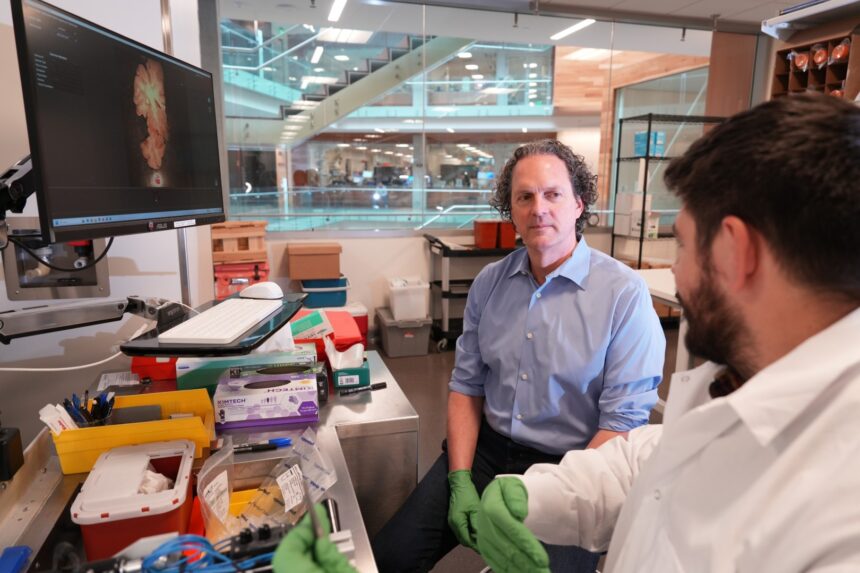
The goal is “a whole new brand of therapeutics that, instead of targeting a protein, targets the cells in the circuits that are affected in disease,” said Ed Lein, Allen Institute executive vice president and director of the Brain Health Accelerator, in an interview with GeekWire this week.
“This could be a transformative moment for both neuroscience and how we think about treating brain diseases, because this is not what’s happening now,” Lein said.
How it’s funded: The accelerator’s core $200 million in funding comes from the Fund for Science and Technology, which Allen’s estate launched with an initial $3.1 billion endowment to support work in bioscience, the environment, and AI.
Allen, who died in 2018, directed that proceeds from his estate go to philanthropy. His sister, Jody Allen, who chairs the foundation, is overseeing the sale of assets including his sports franchises, the Seattle Seahawks and Portland Trail Blazers, with a large portion of the proceeds expected to flow to the foundation’s science and technology work.
The commitment to the new Brain Health Accelerator runs over 14 years, and Lein said he expects the accelerator’s total funding to grow as the initiative adds partners.
It will also draw on federal funding, including grants from the National Institutes of Health. Asked about the impact of the squeeze on federal science funding, Lein described the relationship with NIH as mutually beneficial: philanthropy builds research infrastructure, federal grants help run it at scale, and the resulting data becomes a public resource.
“You could call it even a public-private partnership,” he said. “I wouldn’t say we can’t do it without them, but I would say we can’t do as much without them.”
Going from brain maps to therapies: The initiative builds on the Allen Institute’s more than two decades of work mapping the brain. Advances in single-cell genomics in recent years let researchers catalog the human brain at a resolution not previously possible, defining thousands of distinct cell types by their genes.
Lein called it “the equivalent of the human genome meets Google Earth” — a reference map that lets scientists see disease at the level of specific cells and circuits for the first time.
The same map provides new opportunities to treat disease. It shows the genetic switches that turn genes on in specific cell types, which lets researchers design tools to target those cells. The potential outcome is a gene therapy that acts only on the cells a disease affects.
What’s ahead: The accelerator’s stated goal is to reach a clinical trial within five years.
Lein was careful not to say which disease might be the subject of the first trial, but acknowledged that ALS looks promising. Researchers already know which cells the disease attacks — motor neurons in the spinal cord and cortex — and in some cases its genetic cause. ALS also progresses quickly, which can make patients more willing to try experimental therapies.
“We haven’t done this before,” Lein said. “We’ve been descriptive in our nature for our whole existence, and now we want to try to do something with that knowledge and those tools.”
The role of artificial intelligence: Recent advances in AI, including foundation models, give researchers new ways to find patterns and model how disease develops.
“The size of the data is really going to be unlike anything we’ve done before, and that’s incredibly well-suited to foundation modeling and new methods in AI,” Lein said.
Partners on the initiative include Amazon Web Services, which the Allen Institute has worked with for years. Lein said the institute is also beginning to collaborate with the Allen Institute for AI, or Ai2, the independent Seattle-based organization that Allen founded separately.
The accelerator’s collaborators include more than two dozen universities and research institutions, including the University of Washington, Stanford, MIT, Fred Hutch, and the patient-advocacy group EverythingALS, with international partners such as the Sanger Institute in the U.K. and Riken in Japan.
Allen’s legacy: Lein has been at the Allen Institute since 2004, when he joined as its first neuroscientist. He said the work is now starting to realize Allen’s larger ambitions.
“I feel really good, and really sad that Paul’s not here to appreciate it,” Lein said. “He was very curiosity-driven, but ambitious, and he hoped that we would eventually get to things that had an impact on human health. I think we’re finally there.”
Read the full article here