
Amazon Leo is still months away from the commercial launch of its satellite broadband network, but there’s already at least one satisfied user: Rajeev Badyal, who heads up the Amazon Leo team.
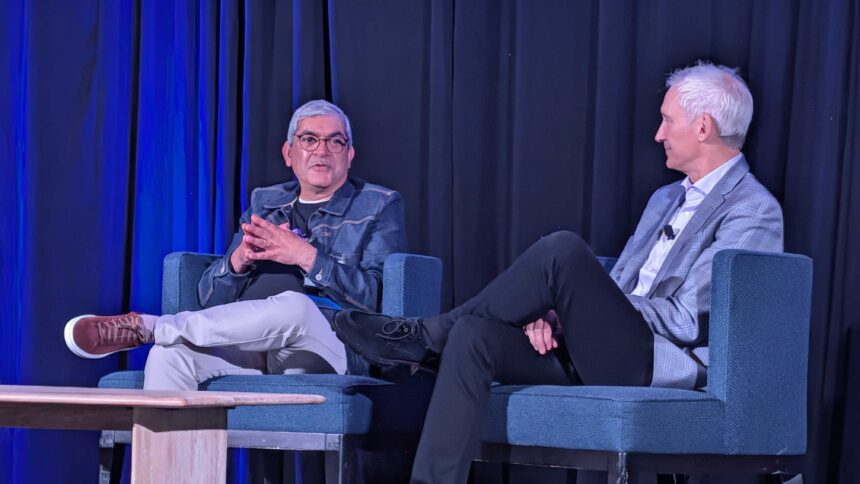
“I was in a remote location last week,” Badyal said today at the Technology Alliance’s annual State of Technology Luncheon in downtown Seattle. “I had the terminal with me. … I was in a place surrounded by mountains. I go, ‘There’s no way that we can make it here.’ The team said, ‘Just go put it there, we’ll take care of the rest.’ And they did it. It worked flawlessly.”
Badyal said he and his wife even streamed a movie in an isolated location where their phones couldn’t pick up a signal. “We were both like two kids who had never seen the internet before, discovering the internet for the first time,” he recalled.
For now, Badyal and other insiders are the only ones trying out Amazon Leo’s satellite service on a beta-testing basis, but it won’t be long before the first customers will be able to sign up.
Badyal can hardly wait. “That, to me, is the ultimate milestone,” he said. “That’s why all of us have been working on this — to get it out there, get it in the hands of the customers.”
Amazon Leo won’t be entering virgin territory. For years, SpaceX’s Starlink network has enjoyed the dominant position in the market for satellite broadband services via low Earth orbit. Starlink currently has more than 10,000 satellites in orbit, serving more than 10 million customers around the world.
Amazon Leo currently has a little more than 300 satellites in orbit, one year after its launch campaign began in earnest. Over the next year, the team expects the pace to pick up dramatically. “Just a little over a year ago, we used to make one satellite a month, and that was 24/7,” Badyal said. “Now we can do tens of satellites a week at our factory in Kirkland.”
By mid-2029, Amazon is due to have more than 3,200 satellites launched on rockets provided by United Launch Alliance, Blue Origin, Arianespace and even SpaceX, under the terms of its license from the Federal Communications Commission. And it’s already received the FCC’s preliminary go-ahead to add another 4,500 second-generation satellites to the network.
Pieces of the puzzle are coming together on the consumer side as well: Although Amazon Leo hasn’t yet announced plans for pricing and availability, it has released information about three levels of service, offering downlink speeds that range from 100 megabits per second to 1 gigabit per second. This week, the FCC released information about Amazon Leo’s Wi-Fi routers.
During today’s luncheon presentation, Badyal and Chris Weber, Amazon Leo’s vice president for business and product, shared a few inside stories about the network’s development.
How it all began
Before joining Amazon, Badyal worked at Starlink’s satellite development operation in Redmond, Wash., and was famously fired by SpaceX CEO Elon Musk in June 2018. Not long afterward, Badyal met with Amazon founder Jeff Bezos, who he said was “extremely passionate and bullish” about creating a satellite broadband network.
“The next thing you knew, I said, ‘OK, I will come and help you build this constellation and make this vision come true,’” Badyal recalled. “And we joined in October.”
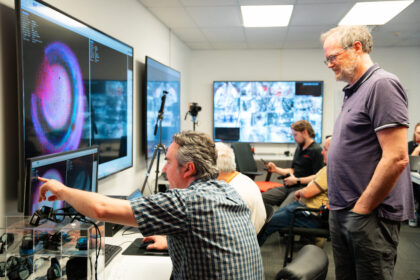
Badyal and five other engineers worked out the design for the satellite constellation in an office that was blocked off with curtains. “These were black curtains, and it basically said, ‘Keep Out,’” Badyal said. The engineers wrote up a vision document that ran longer than Amazon’s traditional six pages. “It was harder to write the document than it was to design the constellation,” Badyal joked.
“In January of 2019, we were in front of Jeff. He had just come back from an earnings announcement, and he had the 40-page document in his hand,” Badyal said. “He puts it on the table, and then he goes, ‘I love this stuff.’ I’ll never forget those words: ‘I love this stuff.’”
How Project Kuiper became Amazon Leo
In the beginning, the network was called Project Kuiper. That was an inside-baseball reference to the icy Kuiper Belt that surrounds the planets of the solar system, in a way that’s similar to the belts of satellites that surround Earth.

“Project Kuiper was a project name, so we knew at some point we’d have to evolve that from a project name to an official brand name,” Weber said. “A couple of things went into it: One is, we had to have a name that resonated globally. Number two, it had to be easy to say.”
“Kuiper” just didn’t cut it. Weber recalled an internal video in which an assortment of influencers pronounced the word as “Ky-per, Kweeper, Cooper, etc.”
“Leo,” on the other hand, resonated. For one thing, it’s easy to pronounce. “Leo obviously gives a nod to ‘low Earth orbit,’ so we like that as well,” Weber said. And putting “Amazon” at the front of the name “really means a lot, around trust and credibility,” he said.
Technological turning points
Badyal said the hardest challenge to solve didn’t have anything to do with the satellites themselves, but with building low-cost customer terminals.
“The challenge for us was, can you integrate what you call a receive antenna and a transmit antenna into a single panel that’s small enough and that’s cost-effective?” he said. “We proved that out in 2020. That was the key pivotal point in the program, where you can say the floodgates were open.”
Another breakthrough came with the development of the optical laser links that transfer data between Amazon Leo’s satellites. Badyal said the first test of the satellite-to-satellite connection didn’t work because the satellites weren’t configured correctly. “It’s always the config file that’s the problem,” he said. After the configuration was corrected, the satellites successfully transferred data at the target rate of 100 gigabits per second.
“I couldn’t believe it,” Badyal said. “I had to call the team that night and just tell them what an incredible job they’d done. For me personally, it was emotional. I had to actually sit down for a little bit, just to collect myself. And I was screaming, by the way, and my wife goes, ‘What went wrong?’”
How satellite broadband will change the world
Weber said learning about potential use cases for high-speed connectivity via satellites is “one of the coolest things in my job.”
“I was in Argentina, and we visited a school where the students have a single cellphone that everyone has to share with a connection that’s less than 3G speed. So essentially it’s almost completely unusable,” he said. “What satellite connectivity will bring to those classrooms there is game-changing, not only for that school [but for] that entire community.”
On the business front, Weber said satellite connectivity will also provide greater resilience for enterprises and manufacturing facilities in case terrestrial coverage goes down. And he said there are “tons of use cases” for government services, including connectivity for first responders in remote locations.
“Everyone in Amazon Leo, they come to this not because it’s a job. It’s because it’s this mission of delivering connectivity to underserved and unserved communities across consumers, government and business,” Weber said. “That’s the thing that we wake up to every day.”
Read the full article here