

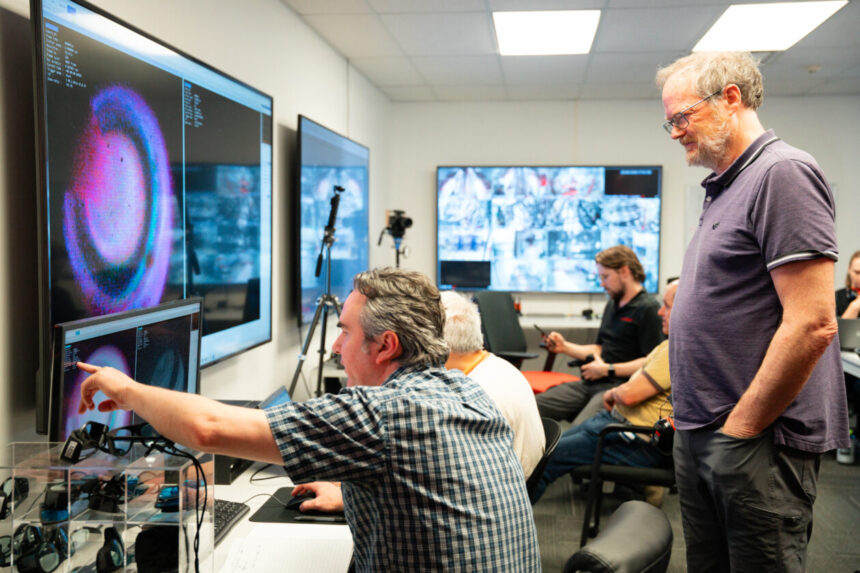
General Fusion’s stock is trading up after it became the first fusion energy company to go public on a major exchange, debuting Monday on Nasdaq.
The launch of GFUZ stock coincided with the release of the Fusion Industry Association’s annual report, which reflected that same investor enthusiasm: private funding for fusion companies totaled $4.5 billion over the past 12 months. One of the biggest rounds went to Helion Energy, a Seattle-area company that raised $465 million last month, bringing its total investment to $1.5 billion.
Soaring energy demand from AI data centers has helped drive interest in the sector as an ambitious slate of companies is building devices that create and contain plasma — a super-hot, fourth state of matter required for atom-smashing fusion to occur.
For decades, researchers have chased this clean energy source, aiming to replicate the reactions that power the sun, a churning ball of plasma. While significant progress has been made, big technical hurdles remain, and it’s uncertain when the goal will be reached.
But the promise of fusion is so enticing that the risks appear worth it for many investors.
“A commercial fusion industry is a world-changing industry, and the returns on investment will be massive,” said Andrew Holland, CEO of the Fusion Industry Association, in the foreword to the report.
The sector has landed more than $13.3 billion from venture capitalists over the past five years, according to the annual survey. After decades of government support via national labs and R&D grants, the private sector is now picking up the majority of the tab for fusion’s progress.
One of the important milestones in the pursuit of fusion is “scientific breakeven” — the point at which the output of a fusion reaction matches the energy input to a device’s plasma, without including the rest of the system’s power needs. Scientific breakeven was first hit by Lawrence Livermore National Laboratory in 2022, but has not been reached by a private venture.
To be financially viable, the fusion companies need to go further, capturing more energy from fusion than required to operate their whole system.
The new report includes profiles of 56 companies worldwide that are pursuing fusion, including four based in the Pacific Northwest: General Fusion, Helion, Zap Energy and Avalanche Energy, as well as Kyoto Fusioneering, which has an office in Seattle.
Here’s a closer look at the four companies based in this region:
Avalanche Energy, Seattle
- Notable fact: Avalanche is unusual for its small-scale approach to fusion, and its plan to launch a pilot plant by 2030 is among the earlier targets in the race.
- Year founded: 2018
- Target uses: Electricity, space propulsion, marine propulsion, off-grid energy
- Publicly shared total funding: $104.2 million
- Target for scientific break even: 2029
- Target for first pilot plant: 2030
General Fusion, Vancouver, B.C.
- Notable fact: General Fusion has made multiple pivots in recent years in its path to commercialization and was the first to go public.
- Year founded: 2002
- Target uses: Electricity generation
- Publicly shared total funding: about $500 million
- Target for scientific break even: Not disclosed; aiming to produce fusion conditions by 2028
- Target for first pilot plant: Approximately 2035
Helion, Everett, Wash.
- Notable fact: Helion was the first to sign up a fusion customer when it inked a deal with Microsoft in 2023, and aims to be the first to reach commercialization.
- Year founded: 2013
- Target uses: Electricity generation
- Publicly shared total funding: $1.5 billion
- Target for scientific break even: Not disclosed
- Target for first pilot plant: 2028
Zap Energy, Everett, Wash.
- Notable fact: Zap recently announced it will also pursue nuclear fission energy, building small-scale reactors alongside its fusion work.
- Year founded: 2017
- Target uses: Electricity generation, off-grid energy, industrial heat
- Publicly shared total funding: $338 million
- Target for scientific break even: Not disclosed
- Target for first pilot plant: Late 2030s
Read the full article here