

Jeff Bezos’ Blue Origin space venture is still assessing the damage from this week’s catastrophic New Glenn rocket explosion on the company’s Florida launch pad, but it’s already clear that it will take months to make repairs and return to flight. So, what does that mean for Blue Origin and its customers?
“I guess the short answer, without pontificating, is that everybody gets delayed,” said Caleb Henry, director of research at Quilty Space, a Florida-based industry research institute.
Thursday night’s blast occurred during a static-fire test for the heavy-lift New Glenn rocket, which was nicknamed “No, It’s Necessary.” The launcher was due to put 48 satellites into low Earth orbit as early as next week for Amazon Leo’s high-speed internet network.
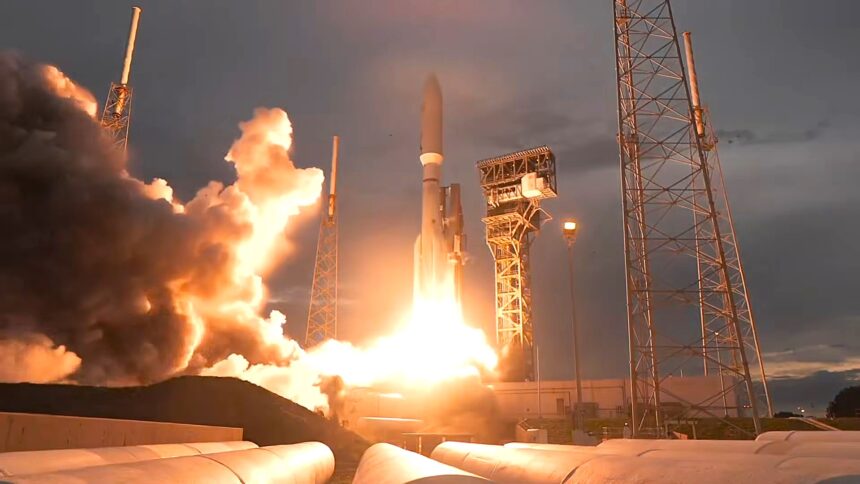
That launch is now off the table, but Amazon Leo (formerly known as Project Kuiper) is still pushing ahead with satellite deployment in anticipation of kicking off commercial service as soon as this summer. Not far from Blue Origin’s ruined pad at Cape Canaveral Space Force Station’s Launch Complex 36, United Launch Alliance sent 29 Amazon Leo satellites into orbit today on an Atlas 5 rocket.
Amazon has also reserved dozens of future launches on Arianespace’s Ariane 6, ULA’s next-generation Vulcan and SpaceX’s Falcon 9. “Weirdly, as far as New Glenn customers go, Amazon is probably in the best position to deal with this setback,” Henry said. “They’ve got safety through the diversity of their launch supplier base, where if one company goes down, they can depend on another to keep the constellation going.”
Nevertheless, there is a limit. “If they were depending on Blue Origin to get them over the hump to the minimum number of satellites they have deemed necessary for turning on service, that goal is going to take a little bit longer,” Henry said.
How long will it take to get the New Glenn rocket back on track? “If we were looking at something that was purely just a rocket failure, then I would say three to six months is the expected range for a return to flight,” Henry said.
But it’s not just a rocket failure. Extensive damage was done to the launch pad and its surroundings. “We haven’t had that many launch pads that have been destroyed, which is a great thing,” Henry said. “I would look at how long it took SpaceX to get back to flight after the AMOS-6 failure back in 2016. That’s probably the best proxy for this kind of thing.”
It took SpaceX 15 months to repair its pad at Cape Canaveral’s Launch Complex 40 and resume launches. In the interim, SpaceX continued to send up rockets from alternate launch pads, but that option isn’t immediately available to Blue Origin. Launch Complex 36 was the only Blue Origin facility capable of accommodating New Glenn. Additional pads are being planned in Florida and California, but those plans are still just in their beginning stages.
Not good news for NASA
If it takes more than a couple of months to get New Glenn back in service, that will add complications to NASA’s plans for sending astronauts to the moon and eventually building a permanent lunar base. New Glenn was due to launch Blue Origin’s robotic Blue Moon Mark 1 lander to the moon this fall with NASA payloads on board, partly to test technologies for a crew-capable Mark 2 lander.
There was a chance that the Blue Moon Mark 2 lander might be tested in low Earth orbit next year during NASA’s Artemis 3 mission. But with New Glenn sidelined, the timeline for developing the Blue Moon architecture faces steep hurdles. That will force NASA to rely more heavily on SpaceX’s Starship, which is navigating its own developmental challenges.
NASA is planning to use either Starship or Blue Moon to put astronauts on the lunar surface in 2028 during the Artemis 4 mission. And just this week, NASA announced that it had chosen Blue Origin, New Glenn and Blue Moon to deliver two lunar terrain vehicles to the moon in time for those vehicles to be used by the Artemis program’s astronauts.
John Logsdon, the founder of George Washington University’s Space Policy Institute, told Time magazine that the New Glenn explosion raises fresh questions about those plans. “This incident certainly throws a monkey wrench in the Artemis schedule, which was probably not achievable even before the explosion,” Time quoted Logsdon as saying.
NASA Administrator Jared Isaacman acknowledged the challenge today in a memo sent to agency employees. “I am sure it is not lost on anyone how this situation could potentially impact our Artemis and Moon Base ambitions,” he wrote. “I also know that most of you chose careers at NASA because you thrive in challenging circumstances. This moment is challenging, but it is far from insurmountable.”
A reminder that ‘rockets are hard’
NASA isn’t the only government customer for New Glenn launches. The Pentagon is also planning to use the rocket for national security launches. Despite this week’s explosion, the U.S. Space Force announced today that Blue Origin was receiving a task order from the National Reconnaissance Office for a New Glenn launch in the 2027-2028 time frame.
“This anomaly is a solemn reminder that the critical capability this community provides is rocket science and inherently challenging,” Space Force Lt. Col. Doug Downs said in a news release. “The National Security Space Launch program will continue working closely with our Blue Origin partners to help identify the root cause and implement corrective actions.”
According to Henry, one of the biggest losers — at least in the short term — is AST SpaceMobile, which planned to lean on the heavy-lift New Glenn rocket to launch its BlueBird satellites for direct-to-device connectivity. The first such launch took place last month, but AST’s satellite was sent into the wrong orbit.
The fact that New Glenn is now out of commission just adds to AST’s woes.
“If you look at their satellite design, they have very big satellites, which means they can’t fit that many on other rockets, even the Falcon 9,” Henry said. “AST is the poster child for the perfect New Glenn customer. … Now they’re going to have to wait longer, or depend more heavily on other launch providers.”
Finding those alternatives “might be easier said than done, because we’re in the fourth year of a global shortage of commercial launch supply,” Henry said.
AST’s share price dropped about 15% today, and other publicly traded space companies saw their value decline as well — perhaps at least in part because the New Glenn explosion reminded investors that, as SpaceX CEO Elon Musk put it, “rockets are hard.”
Read the full article here