

It was on something of a lark that Heather Koponen went to a screening of “Dark Waters” — the Mark Ruffalo film about dangerous “forever” chemicals fouling creeks and drinking water.
She really liked the movie and took home a free test kit offered by the nonprofit that organized the event to check her own drinking water for the pollutants, known as PFAS.
Koponen, a retired physician’s assistant, lives on the outskirts of Fairbanks, Alaska, in a home that once belonged to her parents. She knew about PFAS contamination in the area from firefighting foams used at military bases and airports, and had local friends who believed their health had been harmed by the chemicals. Koponen thought she was in the clear given her location relative to potential sources.
“Surprise, surprise, the well that my parents had put in in 1966, had the best-tasting water in the world and was west of the known contamination, turned out to have high levels of PFAS,” Koponen said. “We didn’t believe it, so we tested again, multiple times.”
PFAS — a family of industrial chemicals used in non-stick pans, food packaging, and as a grease and water repellent in clothes and carpets — contaminate water and soil across the U.S. and the world. Most people have detectable levels in their blood.
The chemicals are linked to reduced immune response, developmental delays in children, increased incidence of some cancers and hormonal impacts such as decreased fertility.
As PFAS have spread through the environment, strategies for controlling and destroying the persistent pollutants have been in short supply and extremely costly.
Now, decades into the problem, that’s finally changing. On this debut episode of Positive Charge, GeekWire’s podcast about hope in the sustainability and climate fight, we go inside the effort to build and deploy technologies that can effectively destroy PFAS. Two companies at the forefront are based in Western Washington: Aquagga and Sedron Technologies.
Blasting PFAS in Tacoma
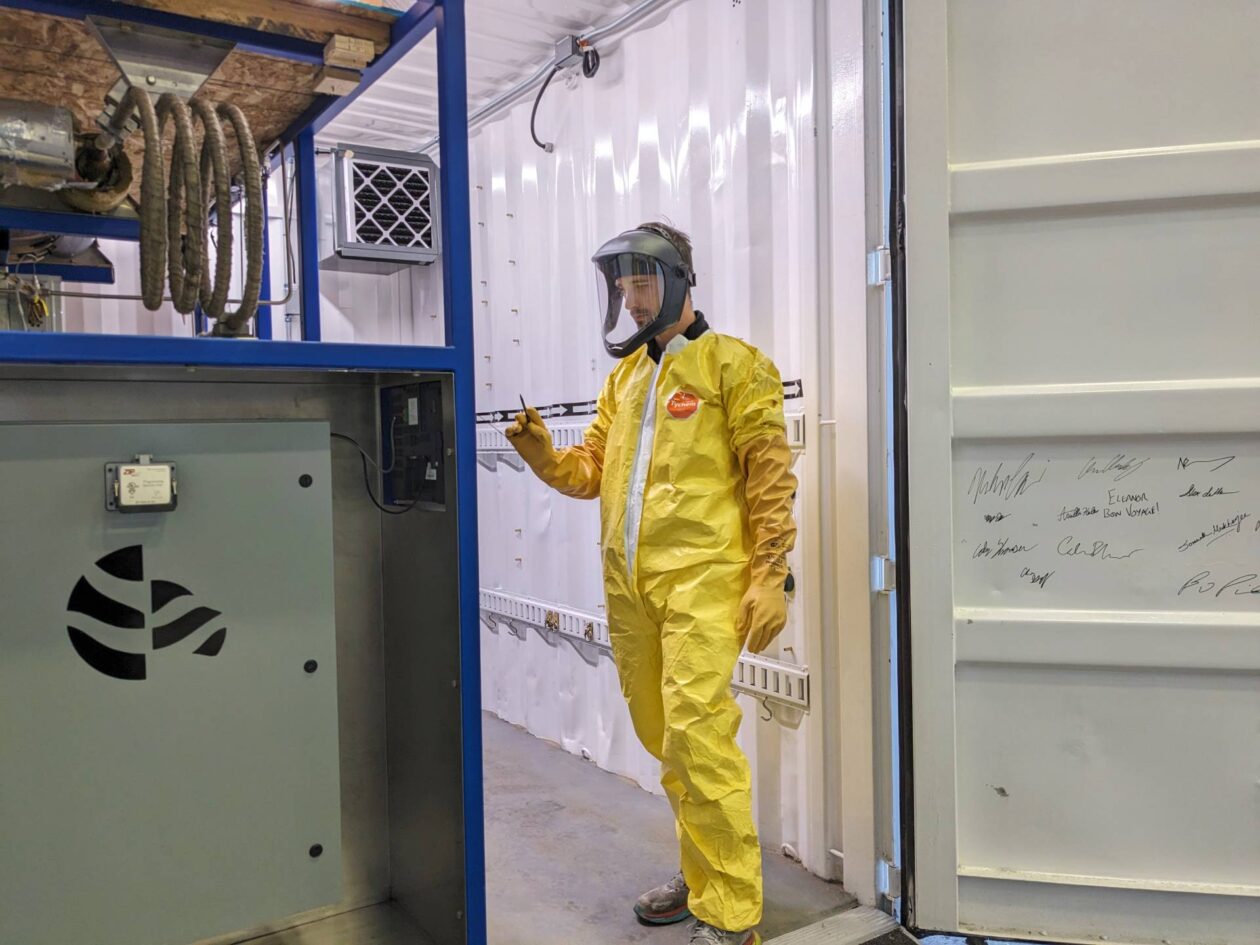
Located in downtown Tacoma, Aquagga does its R&D work inside the Petrich Marine building — a former marble works facility on the industrialized Thea Foss waterway. Inside the cavernous wooden structure, the startup builds devices that treat PFAS pollution from concentrated sources, housed in easy-to-move shipping containers painted bright white.
“We can step inside,” said Brian Pinkard, Aquagga’s co-founder and chief technology officer, letting visitors inside one of the containers. “It’s a little dirty. Watch your step. Just don’t touch anything. That’s the one rule.”
The system uses hydrothermal alkaline treatment, or HALT, blasting PFAS with high temperatures and extremely alkaline conditions — imagine a very strong bleach. Contaminated wastewater flows through the machine, and the process breaks the chemicals into smaller, nonhazardous components, including carbon and fluoride compounds.
What comes out isn’t drinking-water safe, but the technology destroys more than 99.99% of PFAS.
In recent years, Aquagga has treated contaminated water from various sources, including a lined underground pit that once held 20,000 gallons of waste at Fairbanks International Airport. A project with the Department of Defense treated 3,000 gallons of waste in North Carolina. DOD alone has an estimated 2 million gallons of PFAS-containing firefighting foam stockpiled for disposal.
Turning waste into a weapon against PFAS
Sedron wasn’t launched to battle PFAS. It set out to purify sewage waste into drinkable water — which it once served to Microsoft co-founder Bill Gates.
Janicki Industries, an aerospace engineering and manufacturing company, received funding in 2011 from what is now the Gates Foundation. The philanthropy wanted a wastewater purification system for use in developing countries. That project led to the creation of Sedron.
The company developed systems to treat dairy waste and municipal biosolids — the residual product from wastewater treatment plants. Sedron dries the biosolids in an energy-efficient thermal dryer, turning them into a biofuel fed into a biomass boiler. The boiler generates electricity that cycles back to power the dryer and produces excess clean energy sold to the grid.
The system also destroys PFAS that contaminate sewage waste, having escaped from consumer goods or passed through humans.
“When you’ve got biosolids in these thermal systems that are heated above 900 degrees Celsius, they’re in there for over two seconds, and there’s enough turbulence within that system, the literature suggests, that PFAS is destroyed,” said Meghan Carlo, Sedron’s senior permit manager.
Without this treatment, biosolids would typically be returned to the environment as fertilizer spread on farms, golf courses or similar sites — keeping PFAS in circulation.
The long road to clean water
Solutions for cleaning up PFAS exist, but the scale of the problem is staggering. One academic study estimated the cost of removing a subclass of PFAS from the environment at the same rate they are released: somewhere between $20 trillion and $7,000 trillion per year.
In 2024, the Biden administration established the country’s first drinking water limits on six forms of PFAS, setting a ceiling of 4 parts per trillion — roughly a tiny drop of water in five Olympic-sized swimming pools. The Trump administration is moving to cancel limits on four of the six and delay compliance for the other two.
States are forging ahead with their own restrictions on PFAS in drinking water, including monitoring requirements and limits on how and where the chemicals can be used. The resulting liability concerns for municipalities and other stakeholders are stoking demand for cleanup technologies.
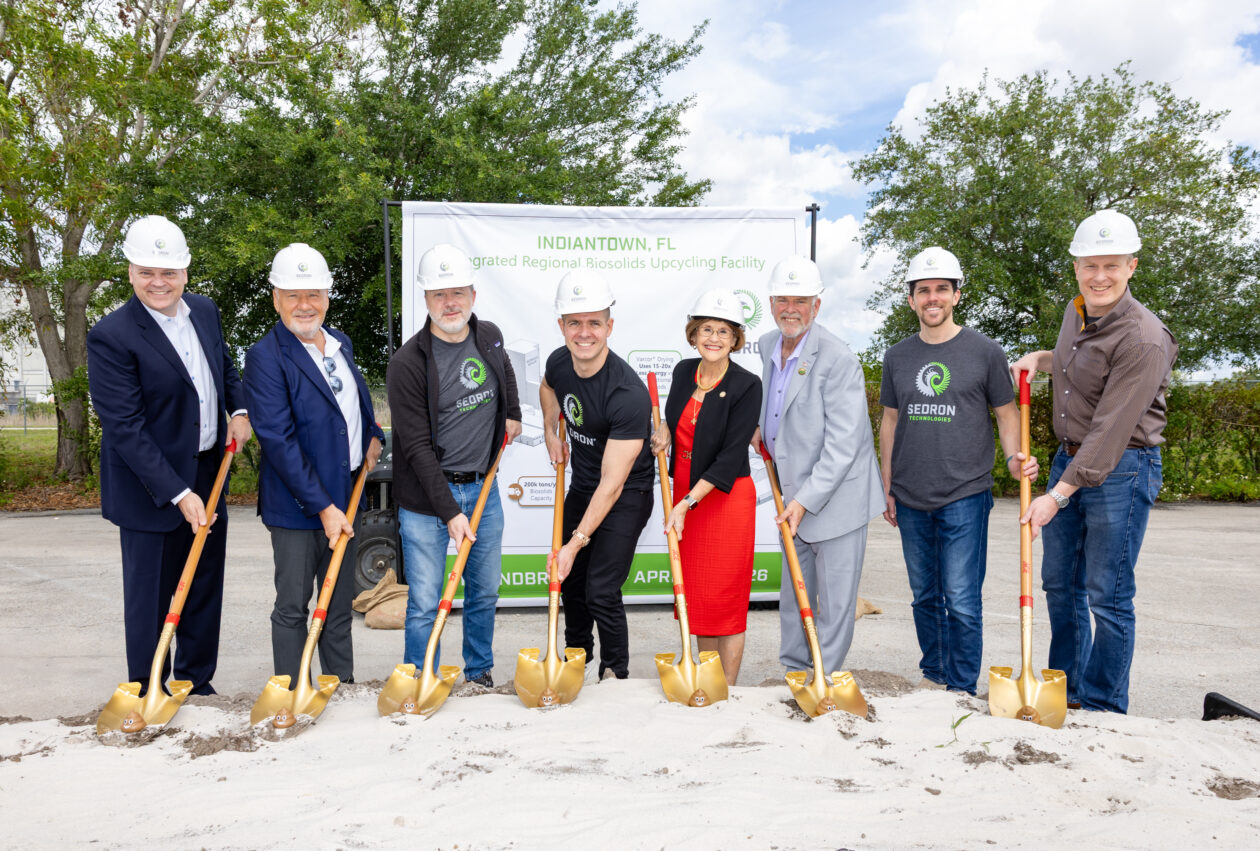
Aquagga has devices available for lease, purchase or demonstration projects. Sedron broke ground this year on a regional waste treatment facility in South Florida that will serve municipalities home to 2 million people, with operations expected to begin in 2028.
Fairbanks resident Heather Koponen needs a solution now. Her options include an hour-long round trip to a natural spring to fill five-gallon jugs, deliveries from a local company whose water appears to have low-level PFAS contamination, or PFAS filters similar to a Brita.
But she’s also focused on the bigger picture.
“The most important thing is to stop more contamination,” she said. “We’ve got to think of future generations and the future planet.”
Sources and references
Interviews:
- Brian Pinkard, Aquagga, co-founder and chief technology officer
- Heather Koponen, Fairbanks, Alaska, resident impacted by PFAS
- Stephanie Dotterer, Sedron Technologies, director of strategy
- Meghan Carlo, Sedron Technologies, senior permit manager
Additional sources:
Read the full article here