

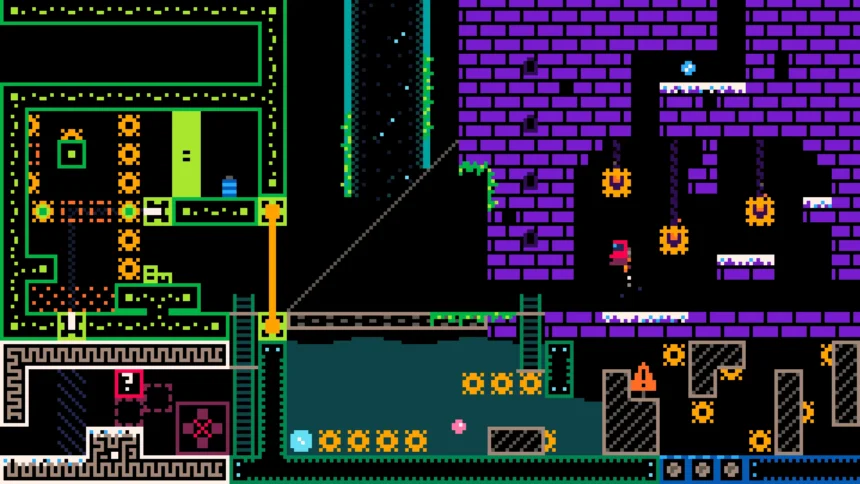
A couple of weeks ago on X, someone reposted Braid and The Witness creator Jonathan Blow into my feed. He was sounding off about a new indie action-platformer called Derelict Star that I hadn’t heard of, but which has quietly gained an audience among movement platformer enthusiasts since its release in early April.
Blow was not impressed.
“The intro level made me rage quit, unfortunately,” he wrote, before veering into sarcasm. “‘Haha here are a bunch of jumps that are hard in an uninteresting way like every other game, but we are going to give you controls that are clunkier than any other game, and we won’t polish them…'”
“No time for that,” he added. “If there is something more interesting about the game it should not be gated behind stuff like this.”
My interest was piqued, mostly because I know Jonathan Blow likes platformers. He’s made one after all. I once watched him play and commentate on the design of 1001 Spikes. What kind of platformer could get his knickers in such a knot? I wishlisted Derelict Star and promptly forgot about it.
But then a few weeks later someone suggested in an email that I try Derelict Star because I love N++, and that recommendation tipped me over the edge. I bought it, I’ve sunk around six hours into it, and, well, look: Jonathan Blow is entitled to his opinion, but he is cosmically wrong about this one. Derelict Star is a gem.
Jetpack Joyride
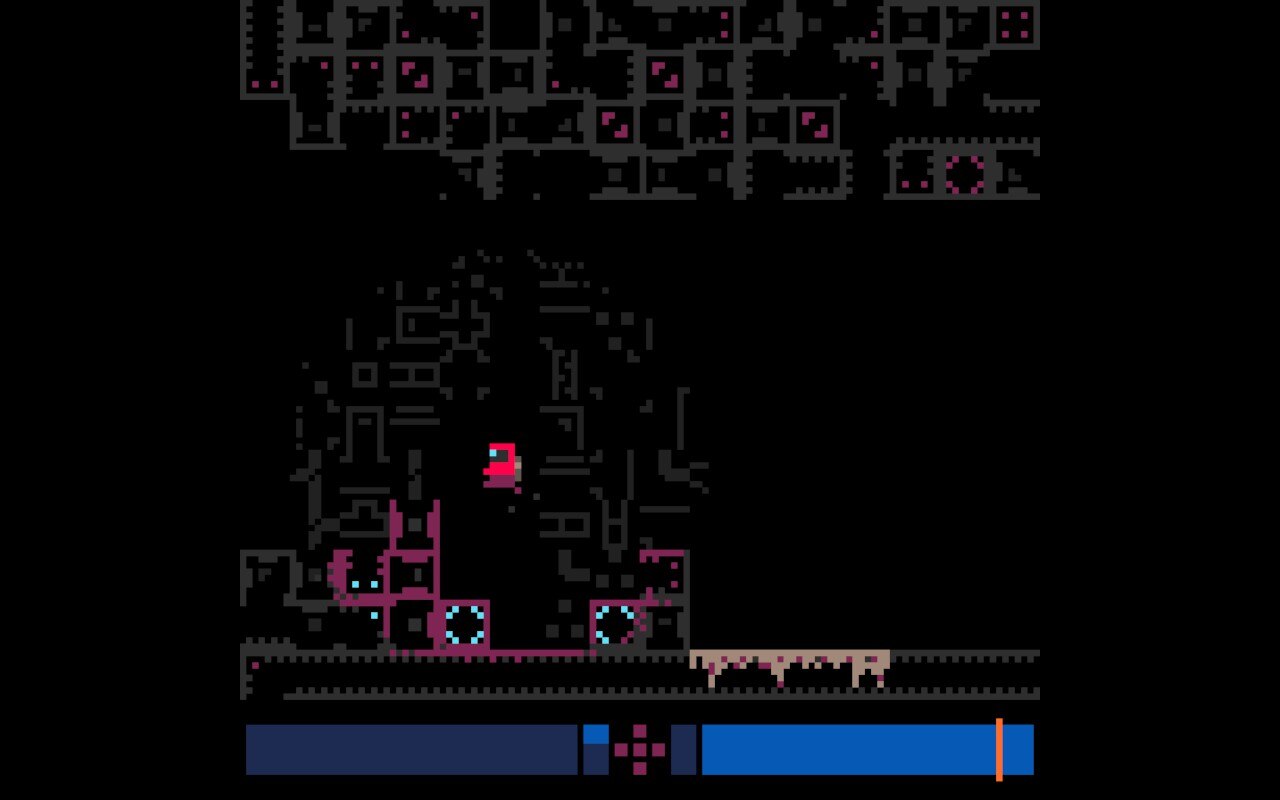
Derelict Star follows the travails of an unnamed astronaut whose spaceship has run out of power enroute home. To escape a lonely death they must pillage power cells from an abandoned freighter. Naturally, these power cells are not stored in a convenient room right near the entry.
It’s essentially a metroidvania consisting of around 500 discrete screens, with visuals resembling the imaginary Pico-8 console; its chunky pixel art seems to sit on a threshold between the Atari 2600 and 8-bit eras. While it looks gorgeous, the clarity of each pixel’s right angles also feels like a practical consideration; in this precision platformer, you need to be able to see them.
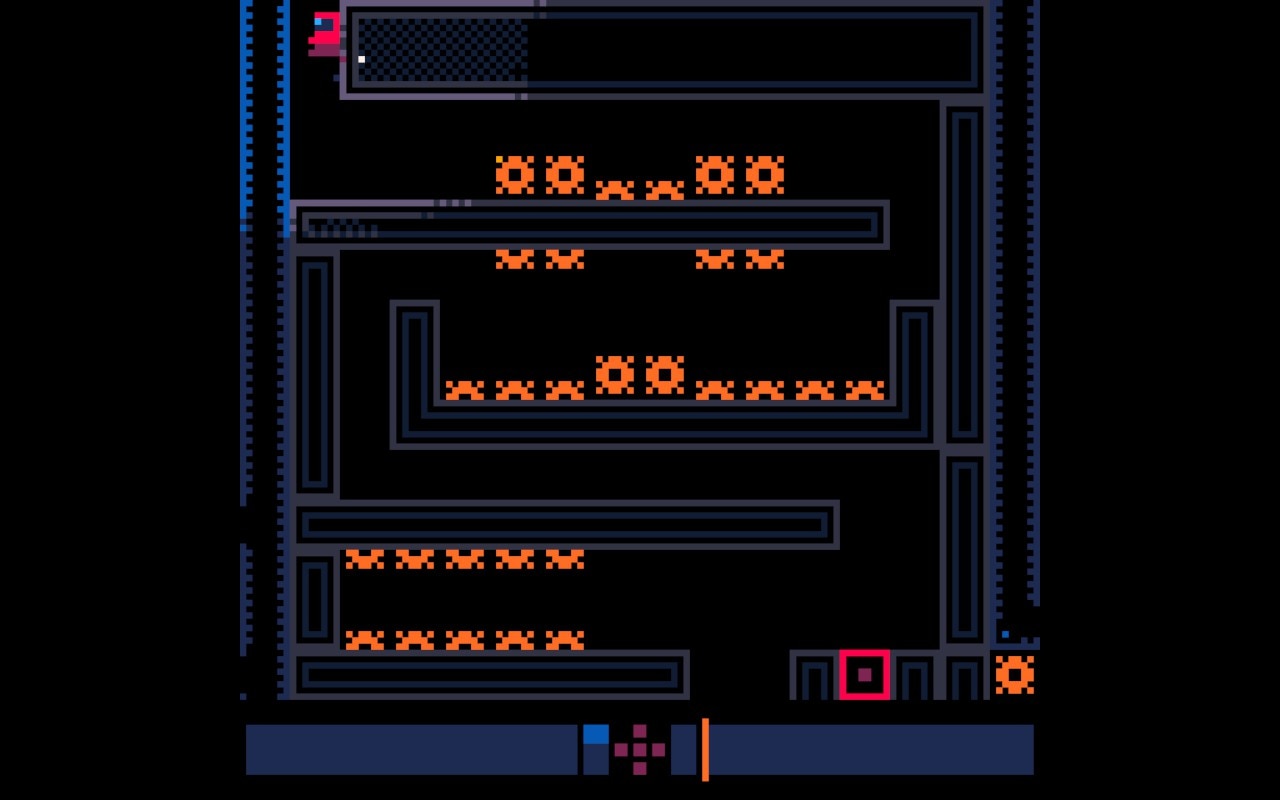
Derelict Star is the most gloriously and pedantically fine-tuned movement platformer I’ve played in recent memory. It hits the same notes that kept me glued to games like N++ and Baby Steps for months. To traverse each screen, the player-character only has their legs, their jetpack, and—hopefully—a growing understanding of how speed and momentum can help them reach heights, or weave through obstacles that initially look impossible.
The first lesson I learn is how high my jetpack can take me from a standing position, which is piddling. But if I run and then trigger my jetpack, I can gain a massive amount of air. When I run I gradually build more and more speed, resulting in higher and higher jumps, but I have to be careful: If I hit my head on a ceiling I’ll wash out and take a plunge, like so:
Derelict Star feels unwieldy and “clunky” for about five minutes. After ten minutes it adopts an expressive fluency. In a way that channels both Rain World and Öoo, after an hour I started to cotton on to finer subtleties of movement through gradual quiet instruction from the game itself, such as the occasional importance of bouncing off walls to gain momentum. This, for instance, would be impossible without slowly getting a feel for this technique:
I mean, this is a game that is always displaying your button inputs at the bottom of the screen. It wants you to take pleasure in the collision of its physics system with your button presses. It wants you to notice, with time, the finer details of its movement system, all the better to nail jumps or thread the needle through gauntlets that seemed impossible two hours ago.
The button input display also features a meter similar to Super Mario Bros. 3’s P-Meter, which indicates how fast Mario is running. As N++ developer Raigan Burns pointed out to me, it’s an exquisitely clever evolution of a mostly superfluous platformer system.
“What I love about this game is that someone took an existing ‘old’ mechanic, the P-meter from SMB3/SMW, and then made a mutant-freak modern reimagining of it, souping it up to be the central ‘puzzle’ mechanic rather than sort of a trivial detail as it was in the Mario games,” Burns said in an email. He’s been praising Derelict Star on Bluesky for months.
“This is beautiful! Maybe sort of like what The Ramones did for pre-Beatles pop music.”
Jumpman
Speaking to PC Gamer over Discord, Derelict Star creator John Williams, aka gate, said watching Super Mario Maker streamers play kaizo Super Mario World ROM hacks helped him gain an appreciation for the complexity of Mario’s moveset in the SNES classic.
“As an example: holding the jump button in mid-air in Super Mario World actually causes you to fall more slowly, but it’s not at all obvious in that game, nor do the levels in the base game ever require it of you,” Williams said. “The astronaut in my game has a jetpack because that’s the visual metaphor I chose to make that mechanic more intuitive.”
“I don’t necessarily mind platformers that control like Mega Man given they’re doing something else interesting, but I do think that stateful, momentum-focused platforming is under-served.”
Williams also cites the original N as an inspiration: “I played a lot of the flash version of N in my youth. I specifically remember reading an article the creators wrote about how they programmed the physics, but at the time I couldn’t really make sense of it.
“The astronaut in my game inherits momentum from platforms and conveyors because it felt important aesthetically for an astronaut to mostly obey physics, and my implementation seems to subconsciously borrow a lot from N. Or perhaps we were presented with similar problems and came up with similar solutions?”
Platformers with a distinctive approach to physics and momentum, from Super Mario World through to the likes of Super Meat Boy and N++, are an increasingly rare species. The pleasure in these games is as much about handling the character—which, with mastery, can feel like performing a lithesome digital ballet—as it is in finally mastering all the levels. I asked Williams if he thought character movement in platformers—the feel of the movement—was an aspect in platformer game design that’s too often ignored.
“It does kind of bum me out that a lot of indie platformers have little to no momentum,” he said. “I don’t necessarily mind platformers that control like Mega Man given they’re doing something else interesting, but I do think that stateful, momentum-focused platforming is under-served.”
He goes on: “Especially in metroidvanias or open world platformers, I think subtleties in the movement mechanics are extremely important. If the second-to-second gameplay is boring for me, then I lose motivation to move around and explore and interact with the game. I want something that will reward me for the attention I give it, and making deep systems that the player has to feel out and experience is a good way to do that.”
Dereliction of Duty
So what does Williams make of Blow’s criticism?
“I do think Blow misunderstood what the game is about,” he said. “His post seemed to imply he thought there was some second layer of puzzles a la Fez or Animal Well and the tutorial was unfairly gating him from seeing those aspects. Derelict Star is almost singularly focused on the subtleties of the movement mechanics, so if he wasn’t enjoying minute ten I think it’s unlikely he would have enjoyed minute 100 or minute 1,000.”
In the original thread Blow is challenged about the extent to which Derelict Star’s controls are unpolished or—in Blow’s words—”clunky”. “There are basic techniques employed by platformers for decades that are not used here,” Blow replied. “But this has nothing to do with my point that if the game gets more interesting in a puzzle adventure way, that should not be gated behind something much less interesting.”
This quote in particular seems to point to a misunderstanding of what Derelict Star is doing, and Williams agrees: “In his critique, Blow calls some design decisions ‘objectively bad’ and I reject that notion pretty wholesale. There are no universal truths in game design; everything has trade-offs. Every decision emphasizes some aspects and de-emphasizes others, and it’s up to the designer to make choices that consistently align with their design goals.”
It bears repeating that Blow is entitled to his opinion (as wrong as it may be!), and highlighting his comments on Derelict Star only serves to magnify the immense, albeit niche, pleasures it contains for sickos like me. Behind its cheerfully primitive facade is a toy I think I’ll muck around with for months, because like all good movement platformers, even when I’m failing it still feels good. I really think you should play it.
Read the full article here