
[Editor’s Note: Agents of Transformation is an independent GeekWire series, underwritten by Accenture, exploring the adoption and impact of AI and agents. See coverage of our related event.]
A new Microsoft study of 20,000 artificial intelligence users in workplaces around the world concludes that the biggest barrier to getting real value from AI isn’t the technology or the workers themselves — it’s the ingrained culture of the organizations where they work.
That “Transformation Paradox” is one of the central findings from Microsoft’s annual Work Trend Index, released Tuesday morning, which paints a picture of employees eager to reshape their jobs and organizations that aren’t really in a position to make it happen.
Sixty-five percent of the AI users surveyed said they fear falling behind if they don’t adopt AI quickly. But only 13% said they’re rewarded for using and experimenting with AI in their jobs.
“Employees are ready to reinvent how they work, but the system around them—metrics, incentives, and norms—continues to reinforce the old way,” Microsoft says in the report.
The takeaway: For companies to truly capitalize on the AI revolution, leaders need to fundamentally overhaul how work is structured, managed, and rewarded, rather than simply handing workers new tools and expecting them to figure it out.
Matt Firestone, general manager of Microsoft’s Frontier Firm initiative, said the message to leaders has changed. Two years ago, executives were under pressure from their boards to unlock value from AI. Now, he said, the message is that their people are already there.
It’s the job of leaders to “re-architect work,” Firestone said in an interview ahead of the report’s release. “Your job is to convert the individual agency and capacity and abilities of your people to unlock that and apply it to increase business value for the enterprise.”
Leaders who encourage employees to experiment with AI and share their experiences create “these incredible systems of learning that drive us forward into the agentic era,” he said.
Of course, this also serves Microsoft’s interests: the company is betting heavily on agents for the next phase of its outsized AI product ambitions, and a report that says organizations need to change how they work is also a pitch for more tools, training, and licenses.
Alongside the report, Microsoft is announcing new capabilities for Copilot Cowork, including a mobile app and a plugin ecosystem for connecting to third-party business systems.
New data on how workers use AI
The report is the latest installment of a survey that has tracked the transformation of work from the early days of the COVID-19 pandemic through the rise of AI in the workplace and the “infinite workday.” Last year’s edition introduced the concept of the “Frontier Firm” and foresaw a world in which workers served as “agent bosses” managing AI teammates.
This year’s Work Trend Index was narrower, covering 20,000 workers across 10 countries, down from 31,000 across 31 countries in recent years. The survey was conducted by Edelman Data x Intelligence. In a new twist, it also excluded anyone who doesn’t already use AI at work.
As it has in the past, Microsoft also analyzed trillions of anonymized productivity signals from Microsoft 365. The company partnered with Harvard Business School and in-house organizational psychologists to interpret the findings.
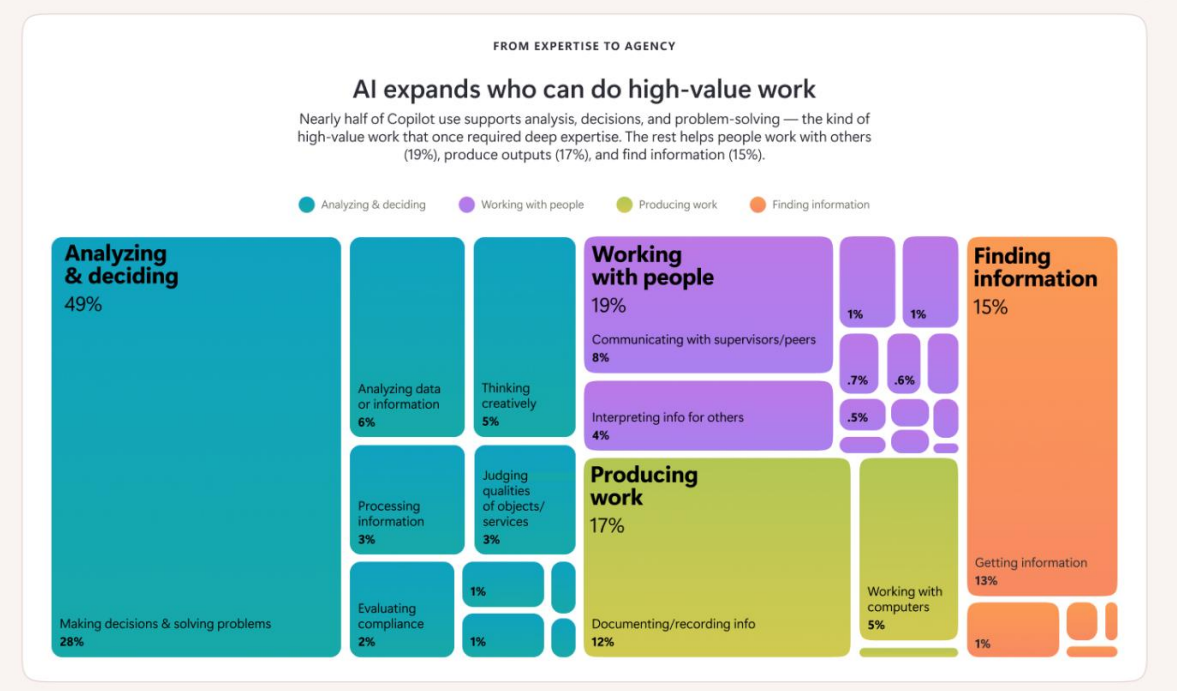
New this year was an analysis of more than 100,000 Copilot chats, classified by the type of work involved. That analysis found that 49% of all Copilot interactions involved cognitive work — analyzing information, solving problems, and thinking creatively — rather than simpler tasks like summarizing documents or finding information.
Microsoft is using that data point to assert that AI is not just making workers faster but expanding the types of work people can accomplish.
The rise of ‘Frontier Professionals’
Fifty-eight percent of AI users surveyed said they are producing work they couldn’t have a year ago, rising to 80% among a group the report calls “Frontier Professionals” — the 16% of AI users who routinely use agents for multi-step workflows, redesign how their work gets done, and share what they learn with their teams.
These Frontier Professionals are also more deliberate about when not to use AI: 43% said they intentionally do some work without it to keep their skills sharp.
The largest group of AI users in the study (42%) sat in what Microsoft called the “emergent” middle, where both individual skills and organizational support are still taking shape.
On the organizational side, the report found that culture, manager support, and talent practices account for more than twice the AI impact of individual factors like mindset and behavior.
When managers actively modeled AI use, employees reported a 17-point increase in the value they got from AI and a 30-point boost in trust in agents, according to a separate Microsoft study of 1,800 workers. But only one in four AI users said their leaders are clearly aligned on AI.
Emerging AI adoption patterns
The report also includes Microsoft’s first Work Trend Index data on AI agents, showing a 15x year-over-year increase in active agents on Microsoft 365, rising to 18x in large enterprises. Microsoft did not disclose the baseline, making it difficult to assess the actual scale of adoption.
The new report says adoption patterns vary by industry. As would be expected, software and technology companies showed the broadest use of agents across job functions.
But Microsoft said it was surprised by the depth of adoption in manufacturing, where fewer companies were using agents but those that did were deploying them heavily in specific tasks. Banking and capital markets, retail, and education also showed significant agent adoption.
In a blog post accompanying the report, Jared Spataro, Microsoft’s chief marketing officer for AI at Work, described four emerging patterns for how humans and AI agents work together:
- Author: The worker produces the work, calling on AI for help as needed.
- Reviewer: The worker sets the intent and AI creates a first draft to edit and approve.
- Director: The worker hands off entire tasks for AI to execute and signs off on the outcome.
- Orchestrator: The worker designs a system where multiple agents run in parallel, flagging exceptions back to the human.
Firestone compared the current moment in AI to the early days of mobile apps, when people were building apps before app stores and permission models existed.
“People are building agents. They’re hobbyists,” he said. “Their personal knowledge is extending the professional workplace. This is a new wave of technology, but all of the fundamental instincts of how to transform the workplace haven’t changed.”
Read the full article here