
Possible Finance CEO Tony Huang describes the startup’s history as “a tale of three chapters.” They could be summed up as a rocket launch, a survival test, and a comeback story.
These days, it’s also feeling like a reunion.
The Seattle-based fintech startup, which provides small-dollar loans as an alternative to payday lending, hit a $125 million revenue run rate last year and posted the first annual profit in its history, recovering from a rough stretch during the pandemic that put its future in doubt.
After cutting more than a third of its staff in 2022, the company is now back in expansion mode, with about 150 people globally, including 50 in Seattle. It’s looking to double the footprint of its offices near Pike Place Market to accommodate as many as 100 people locally.
At the same time, Possible is bolstering its leadership team with new hires. One of the recent additions is actually not new to the company at all: co-founder Prasad Mahendra, who left two years ago to join another startup, returned last month to help lead Possible’s AI initiatives.
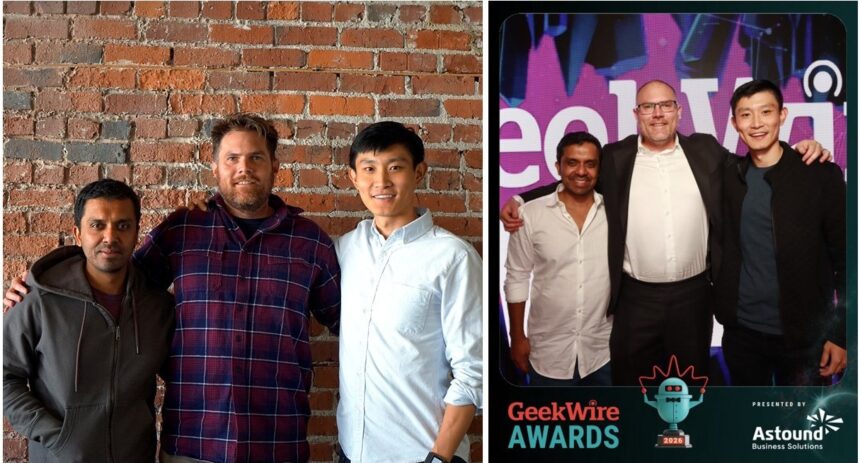
We asked the company’s three founders — Axon veterans Huang, Mahendra, and CTO Tyler Conant — to reprise a photo from the company’s early days in the photo booth at the recent GeekWire Awards (above), where Huang was a finalist for CEO of the Year.
Other new additions to the leadership team:
- Meghan Frazer as chief people officer, a lawyer turned HR leader who previously served as head of HR at construction startup Katerra.
- Craig Anderson, who joined Possible as its general counsel from Revolut after earlier stints at Klarna and Sezzle.
- Jon David as chief product officer, who previously led gaming franchises including Plants vs. Zombies and Bejeweled Blitz at EA and was CEO of Taunt, a Pioneer Square Labs company.
- Bobby McCarty, a former Possible VP of operations who left in 2021 and recently returned, as chief of staff.
Possible offers a technology-driven alternative to payday lending, providing loans of up to $500 through a mobile app with no credit check. Instead of relying on FICO scores, the company uses machine learning to analyze bank transaction history to assess risk.
Traditional payday lenders require borrowers to repay the full amount plus fees in a lump sum on their next payday, and the payments are never reported to credit bureaus, trapping many customers in a cycle of borrowing with no path to better credit.
Possible instead lets borrowers repay in smaller installments and reports the payments, giving customers a way to build their credit scores over time.
Founded in 2017, the company came out of the gate fast, growing to a $44 million revenue run rate by the end of 2020. Then the pandemic hit the business hard. Revenue stalled at $46 million for two straight years, and the company laid off 35% of its workforce.
Huang said the flat stretch forced Possible to rebuild from the ground up. They had scaled too quickly and made mistakes as first-time founders, he said, over-indexing on technology while underestimating the importance of credit risk management and regulatory compliance.
“We focused too much on tech, frankly, not enough on fin,” Huang said. After that, he said, “we brought in experts who helped us do the execution piece much, much better.”
The broader market also shifted in Possible’s favor. During the low-interest-rate years, venture capital poured into fintech startups, and Possible found itself competing for customers against a flood of well-funded rivals. When that era ended, many of those competitors folded or retreated.
Possible, having already cut costs and fixed its fundamentals, was positioned to grow again.
“We basically sobered up at the party a little bit earlier than everyone else,” Huang said.
Revenue climbed to $58 million in 2023 and $79 million in 2024. By December, the company was running at a $125 million annualized revenue rate, and it has since crossed $130 million.
Possible has raised about $55 million in equity funding. Its first backers were Axon CEO Rick Smith and Andy Liu of Seattle-based Unlock Venture Partners. Later investors include Union Square Ventures, Canvas Ventures, and Euclidean Capital, the family office of the late hedge fund pioneer Jim Simons.
Huang said the company is now investing in AI, both to improve internal efficiency and to enhance its lending products, though he said he wasn’t yet ready to share specifics about the latter. That’s part of why Mahendra came back, he said.
The company has also shifted back to a more traditional way of working. Possible went fully remote during the pandemic, hiring people across multiple countries. Huang said the company’s investors told them it was the best distributed culture they’d seen.
But Huang said the company found that remote work required layers of process to keep people aligned, which slowed the team down and made collaboration less creative. Because of that, Possible’s leaders took the investor’s comment less as a compliment and more as a sign that remote work had limits no one had figured out how to overcome.
“We know this is not good enough, and we know that no one’s gotten better than this,” Huang said, describing the thought process about remote work.
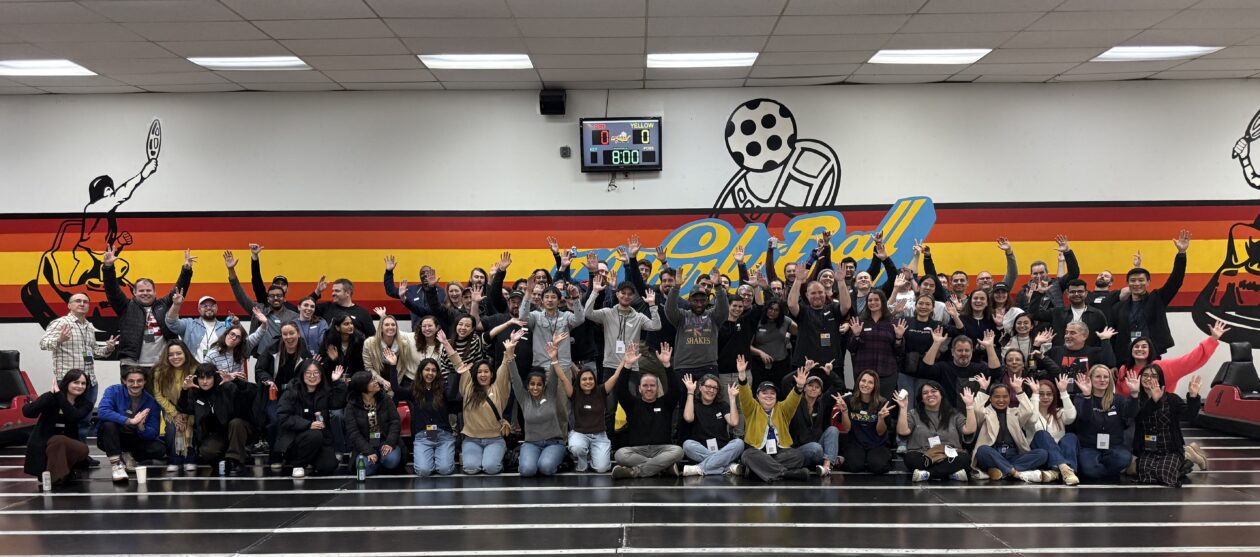
The company now works in-person three days a week in Seattle and flies remote employees in twice a year for a company gathering called Possipalooza. Two senior leaders, Conant and longtime CFO Harsha Srinivas, relocated back to Seattle to be part of the push.
Possible is currently No. 93 on the GeekWire 200, our ranking of the Pacific Northwest’s top privately held startups. It was recently named to the Forbes Fintech 50, an annual ranking of the top private fintech companies in the U.S., the only Seattle-area company to make the list.
Read the full article here