

Nearly five decades after the launch of VisiCalc, AI is reshaping one of the world’s most familiar productivity tools — the humble spreadsheet.
While a lot of knowledge workers interact with spreadsheets on a regular basis, many lack the skills and confidence to access more advanced functions.
“For a very long time, spreadsheets forced you to learn spreadsheet syntax and spreadsheet ways of working,” said Eric Birnbaum, director of product management for Google Sheets. “But think about how many people need to use spreadsheets at work and don’t have the skill set to create the kinds of spreadsheets that can be really helpful for them.”
The addition of artificial intelligence can help handle that issue, he said, making the software more accessible to a wide range of office workers. “AI is unlocking the power of spreadsheets, taking on a lot of the difficult work that’s required to use them. That can be incredibly empowering for users,” said Birnbaum.
Google has steadily expanded generative AI (genAI) capabilities in Sheets since launching Duet AI — now Gemini — for Workspace in 2023.
Gemini in Sheets is available at no extra cost to Google Workspace subscribers, though a paid AI Expanded Access add-on – costing $30 per user each month – is required to remove certain usage limits.
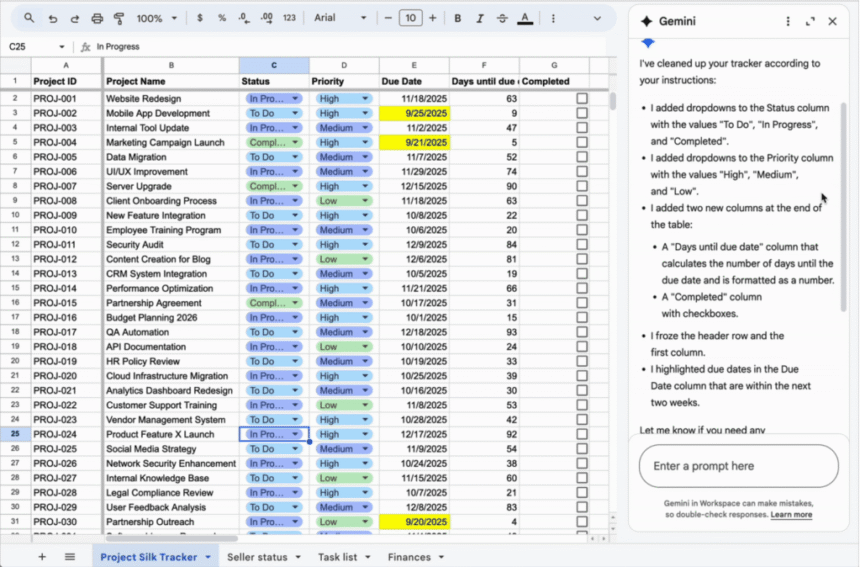
Features that have rolled out in recent months include the ability for a Gemini agent in Sheets to carry out multi-step actions such as formatting, analysis and data entry, and, more recently, the ability to create entire spreadsheets from a single prompt. A Fill with Gemini feature builds on the existing AI function, enabling users to automatically populate selected cells by detecting intent from information within a spreadsheet as well as from the web.
Another feature, Sheets Canvas (currently available in alpha), lets users generate interactive apps that update in real-time based on changes to spreadsheet data. This could be a kanban board for a sales pipeline, for instance, or an analytics dashboard that uses Sheets as its back-end data source.
Google claims users already see a range of benefits from Gemini in Sheets. According to an August 2025 survey of 200 Sheets users conducted by the company, the majority of knowledge workers (89%) said AI features in Sheets save them at least an hour a week, and 88% believe AI features have made them more confident in their data analysis skills.
The most popular AI use cases include creating spreadsheets and charts, analyzing data, and fixing broken formulas. How widely these features are actually used is unclear; Google declined to provide weekly usage statistics for Gemini in Sheets.
As the company embeds Gemini deeper into Sheets, questions remain about just how much businesses can trust AI tools to handle important business data, as well as what increased automation means for those who spend much of their day wrangling data.
Eric Birnbaum, director of product management for Google Sheets.
Computerworld recently talked with Birnbaum about the potential benefits and challenges of the latest evolution of spreadsheet software. This interview has been condensed and edited for clarity.
As businesses become more focused on seeing value from AI investments, what measurable benefits are customers seeing from Gemini in Sheets – for example, time saved or other forms of return on investment? “Spreadsheets remain one of the universal languages for businesses, and we don’t anticipate that’s going to change anytime soon. But by bringing AI into the product where people work, we think it can significantly reduce the technical tax of data: the time spent understanding it, sourcing it, analyzing it, visualizing it.
“Historically, data professionals spent — let’s estimate it at 80% of their time — on the mechanical groundwork, data cleaning, crafting formulas, formatting, troubleshooting, and maybe only 20% of their time on actual strategic decision-making.
“We think that by offloading the manual, time-consuming, error-prone data work to Gemini, we can flip that ratio a bit, so humans can focus on the things that really matter: the high-value questions to ask and the judgment calls and decisions that get made from them. We’re starting to see evidence of that in our own user base and customer base.
“The second point to make is that AI can democratize data analysis to some extent, and make it available to many more users. For so many years, the spreadsheet was a gatekeeper; if you couldn’t speak the rigid language of spreadsheet formulas, you couldn’t extract the value from data. But by introducing these natural language interfaces, AI is separating the analytical capability from the technical literacy.
“If you can ask the right questions, or describe what you want in plain language, Gemini and Sheets can help you achieve your goals in a spreadsheet, even if you have minimal spreadsheet skills yourself.
“What we’ve seen so far from users and customers is that it’s incredibly empowering for people who might have been scared off by data analysis or dreaded opening spreadsheets in the past. You don’t need to go and wait for a data analyst to help you; you can go and do this work yourself in a spreadsheet.”
The flip side is, how confident can businesses be if more junior employees can take on higher-level analysis tasks by relying on AI? Given the propensity for AI models to hallucinate, to what degree can businesses trust that these tools won’t introduce errors into important business data? “It’s something we spent a ton of time thinking about. We’ve gone to great lengths to build these AI tools to collaborate with you, to show their work, explain what they did, and make sure that you can take over where they leave off.
“Our Sheets agent, for example, lays out a really explicit, transparent plan for you to review and approve before any data manipulation happens. It’s designed to do that in plain natural language in a way that the average user could understand, and then it gives you back that final summary, so you know exactly what it did and where it did it.
“The other thing is that the model is great at explaining things. If you inherit a spreadsheet that has some complex formula that you don’t understand, for example, the model does an amazing job of explaining how it works and what it’s doing.
“In many ways AI is not only making these features more accessible, but helping users feel more confident in the output. Human error is an inherent risk in manual data management, with or without AI. One misplaced comma or broken cell reference can completely corrupt an entire financial model, and it can be completely undetected.
“Our approach with AI in Sheets is to create this deliberate verification loop. You now have another spreadsheet expert working along with you, reducing the likelihood of these mistakes.”
Even if humans produce errors too, does it ultimately come down to accountability when AI is involved? “Our point of view here is that AI should be partnering with the knowledge worker who’s doing the work here. And everything that we’ve built is designed to be that partner. You might be able to offload tasks to the model, but we’re citing sources, we’re providing plans and explanations. We’re ultimately relying on the user to do that final verification.
“We spend a humongous amount of time focused on quality. We know that for AI to be useful in spreadsheets, it has to be reliable. When we launched Sheets Gemini Agent, for example, we were really proud that we set a state-of-the-art benchmark on the full SpreadsheetBench data set, which at the time exceeded competitors and near-human expert ability.
“But we know quality is never ‘good enough’ or done. We’re constantly working to improve quality for our users and customers, and for the use cases where they’re relying on AI most.”
What potential do you see for more agentic functionality in Gemini Sheets — for example, bringing in data from other sources, creating recurring reports, or taking more actions independently? “We’re listening closely to customers and users and building what they’re telling us they need. The agent is already capable of doing very complex multistep workflows, and we see users discover that the agent is extremely capable of doing end-to-end spreadsheet tasks. In terms of connectors, in an alpha we have connections available to HubSpot, Salesforce, and Mailchimp. We hope to expand that over time.
“There’s no path to have AI replacing analysts. I think AI is giving analysts more time back to actually do the more valuable parts of their job. Analysts that I work with are way more productive and impactful than they ever were before, because they can push that uninteresting spreadsheet grunt work off to the model, freeing up time for more interesting and impactful work.
“A great example: the visualizations I’m getting back from analysts nowadays are canvases instead of static charts that I can explore myself. It’s way more informative and useful than what I was accustomed to before.”
Looking ahead, do you expect a larger share of spreadsheet work to be carried out by agents, with humans setting goals and reviewing results? What will be the biggest change in how people use spreadsheets with AI? “The tasks are likely to stay similar and the use cases for spreadsheets are likely to continue to be relevant. The biggest change will be the ability to push the uninteresting spreadsheet grunt work off to a model and free up time for the user to do things that are more impactful, more interesting, more meaningful to the business.
‘Spreadsheets have historically been these like static containers where data goes to rest. I think AI can turn spreadsheets into these dynamic, localized software applications. And I do actually think this sort of changes the game for how people might use spreadsheets moving forward.
“It’s not just a passive grid full of numbers; spreadsheets are evolving to become these live, long-lived, collaborative applications. Employees can build these on the fly, like a basic CRM or supply chain dashboard in seconds. This is an area of investment for us moving forward, and we’re really excited to see how this evolves.”
AI assistants and agents, such as ChatGPT or Claude, might be able to analyze spreadsheet files and business data without users working inside a spreadsheet application. What do you think will keep Sheets central to the workflow, rather than simply making it one part of a wider AI-driven process?“We’re in constant touch with customers and users; it’s clear work is still happening in spreadsheets. I think spreadsheets remain incredibly popular tools. If we can bring the AI capabilities users need directly into the product where they already are, we’ll transform the way they work.
“I think we can be the front-end for some of this great AI innovation and the products that users are accustomed to today. Everything we build is guided by user feedback: users are telling us right now they want AI to help them do their everyday or more complex tasks, and they’re starting in Sheets today.”
Read the full article here