
As robots move into shared spaces, coordination failures can quickly become safety risks and operational bottlenecks. For these systems to operate safely at scale, they need a shared way to communicate location, intent, and behavior.
To address this need, Andrew Singletary, CEO of 3Laws, is leading an industry working group with Daniel Theobald, creator of the MassRobotics AMR Interoperability Standard, to develop an interoperability model for heterogeneous robotic systems.
The goal is to move robotics from experimental deployments to a reliable, scalable enterprise utility that organizations can deploy without heavy integration. Updating interoperability standards can turn disconnected machines into a coordinated robotic workforce.
Singletary explained that the original standard focused mainly on sharing state and status information between mobile robots. Integrating robots from different manufacturers, however, requires a significant step forward, as these machines must work together and dynamically adjust their behavior based on what others are trying to accomplish.
“One of the major goals of the new framework is to add intent communication. Instead of just broadcasting status, we want robots to signal what they are trying to do,” he told TechNewsWorld.
Where Robotics Stands Now
The industry is moving toward a model in which facility managers can deploy robots that coordinate immediately, without custom integration.
As more vendors enter the market, closed ecosystems are becoming less viable. Large-scale adopters — from warehouses to hospitals and smart cities — need different robot types to coordinate intent and safety protocols in real time.
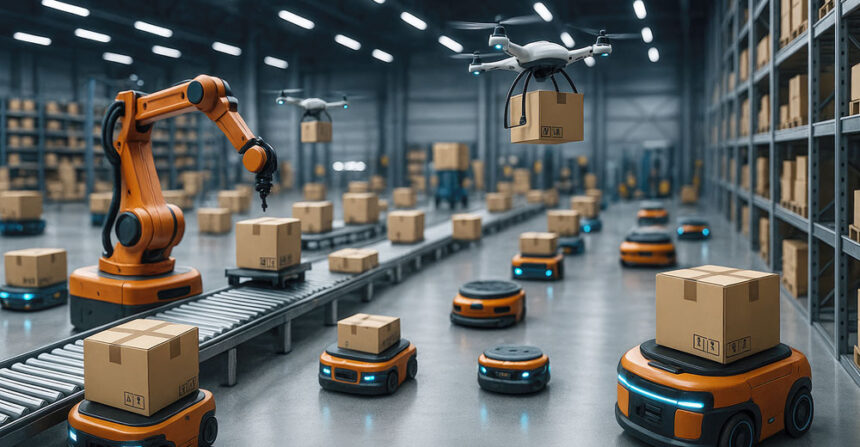
Robots are evolving from standalone systems into self-sustaining infrastructure. They now integrate with building systems such as elevators, doors, and charging stations to operate for extended periods without human intervention.
Advances in AI are enabling robots to move beyond pre-programmed rules, handling real-world environments through natural-language and vision-based commands.
Avoiding Robot Congestion and Conflict
Singletary outlined a typical scenario where robots coordinate without conflict. In a pharmaceutical facility, a mobile manipulator operates at a work cell.
When another robot needs to pass through the same area, it can communicate its intended path or objective. The first robot can respond by signaling whether it will clear the space shortly or remain in place, prompting the other robot to reroute rather than wait or risk a collision.
“This enables robots to communicate more like humans do in shared environments,” he said.
The framework is designed to complement existing fleet management systems, safety standards, and regulatory requirements, not replace them.
From Data Sharing to Coordination
In the autonomous mobile robot (AMR) market, the collaboration between Singletary and Theobald reflects a move from basic data sharing to safety-critical coordination. This shift enables robots to operate without conflict. In practice, that means fewer delays, fewer collisions, and more predictable operations across mixed fleets.
The proposed protocol requires robots to share five core data points: location, speed, direction, health status, and task availability. The standard is being formalized as ISO 21423, with applications ranging from warehouse robots to city-scale deployments.

Together, their work defines both the communication layer and the safety controls needed for robots to operate in shared environments. Theobald developed the communication standard, while Singletary focuses on safeguards that help prevent collisions, even when AI systems fail.
A key challenge is enabling interoperability without exposing proprietary technology.
“The framework is designed to communicate higher-level intent information without requiring access to proprietary control logic, algorithms, or other intellectual property. It would be higher-level things like what the robot is trying to do,” Singletary explained.
AMRs Move Beyond Warehouses
AMRs first gained traction in warehouses. They are now being deployed in hospitals and on public sidewalks. The standard must evolve to account for unpredictable human behavior, not just programmed systems.
“Historically, many industrial robotics standards assumed operation in structured environments alongside trained personnel. Now, we’re entering this new world of robots, where robots will be around untrained people who aren’t necessarily a part of the task that is trying to be accomplished,” Singletary said.
The framework is especially important in these environments, helping robots better account for people.
Individually, these systems have limited sensing capabilities. A person on one side of a facility may only be detected by nearby machines, leaving that awareness isolated without shared communication.
“When robots communicate, it creates a more complete, shared understanding of the environment. That collective awareness helps the overall system operate more safely and effectively,” he said.
Robots Communicate Task Intent
Supporting wheeled, legged, and aerial robots within a single framework is challenging due to their distinct movement constraints. Singletary’s focus is not on robot mechanics but on the task itself.
“The focus is on what the robot is trying to do. We’ve created a working group to define a common, extensible vocabulary of tasks that robots can use to describe intent,” he said.
The challenge is finding the right balance. An overly broad framework creates a complex task vocabulary that is difficult to implement, while one that is too narrow cannot support the range of systems in use.
Singletary said the framework is voluntary, not regulatory, and is intended to encompass all types of robotic systems, from traditional AMRs to humanoids. It will also support hybrid forms, which he expects to gain more traction in the next couple of years.
As deployments expand, getting that balance right will determine how quickly robots can scale beyond controlled environments.
“Finding that balance is one of the harder challenges to solve,” he concluded.
Read the full article here