
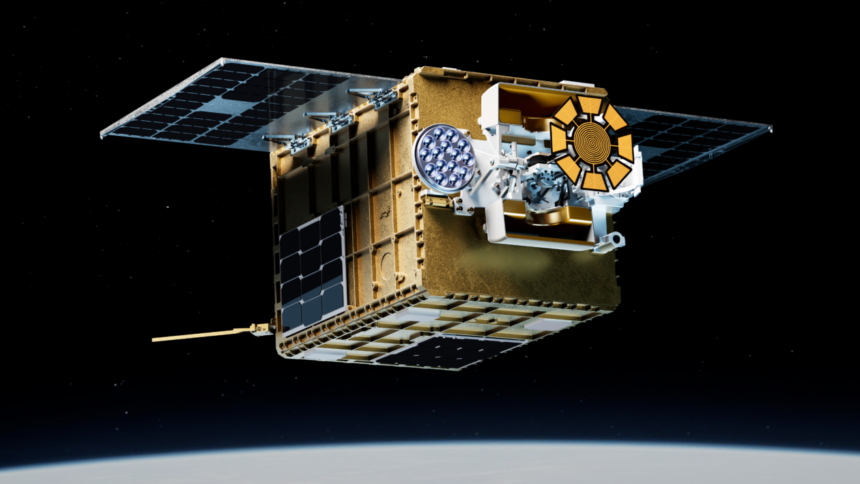
Eleven months after launch, Starfish Space’s Otter Pup 2 satellite is finally kicking its test mission into high gear, closing in for a rendezvous with a newly designated target.
If all goes according to plan, Otter Pup 2 will dock with Australia-based Gilmour Space’s ElaraSat satellite sometime in the next few months. ElaraSat became the new target after earlier plans to connect with a D-Orbit ION satellite were scrubbed for undisclosed reasons.
Trevor Bennett, one of the founders of Tukwila, Wash.-based Starfish Space, said ElaraSat was launched on the same SpaceX satellite rideshare mission that sent Otter Pup 2 into orbit last June. Gilmour Space was “more than willing and excited to jump on and do something a little bit ambitious and crazy with us,” he told GeekWire.
Mark Grimminck, Gilmour Space’s head of satellites, said in an emailed statement that his company was “excited to support Starfish Space on this pioneering mission.”
“Autonomous rendezvous and docking are capabilities that will transform the future of sustainable space operations,” Grimminck said. “Congratulations to the Starfish team on this important milestone.”
The goal for Otter Pup 2 is to test the technologies and procedures for Starfish’s full-scale Otter spacecraft, which is meant to rendezvous with other satellites for inspection, servicing or safe disposal. The first Otter Pup prototype ran into logistical difficulties shortly after its launch in 2023 and wasn’t able to execute a satellite docking, but it did manage to demonstrate some of the technologies that Starfish developed for proximity operations.
An orbital test that was conducted last year in partnership with Impulse Space proved that Starfish’s software suite for guidance, navigation and control could be used on a different company’s satellite to make an autonomous approach to another spacecraft in orbit. Now, Otter Pup 2 is ready to take on the crucial satellite docking.
Bennett said the satellite is still in good health even though it was launched nearly a year ago. “Our goal is to continue to take the actions as we have to keep the vehicle healthy — for a whole year at least — and continue to do so for the next few months as we go through some of these critical, critical next steps all the way up to docking,” he said.
The ability to switch targets from D-Orbit’s satellite to ElaraSat is “a testament to how we’ve designed Otter Pup and some of our core technologies,” Bennett said.
“We can just go switch clients and orbits, and go chase them down, and have both the onboard capacity and the vehicle health and the opportunity through our core technologies that allow us to just go dock with an unprepared spacecraft,” he said.
Over the past couple of months, the Starfish team has been maneuvering Otter Pup 2 into the proper orbit to catch up with ElaraSat. The next phase will be to close the gap between the two satellites to about 6 miles (10 kilometers). Then Otter Pup 2 will transition into an acquisition phase. “Acquisition is the stage for us where Otter Pup’s onboard cameras start taking pictures of a large satellite regularly — lock onto it, if you will — and start maneuvering much, much closer,” Bennett said. “This is what will bring us down to the kilometer-type range.”
Otter Pup 2 will fly itself around ElaraSat for a thorough inspection and calibration of Otter Pup’s sensors and control system. Then the satellite will close in to attach itself to ElaraSat using an electrostatic docking mechanism.
“Our intention is to livestream this, the docking phase of the mission, and actually show the process as we move into docking,” Bennett said. The real-time view will probably be a computer-generated animation based on telemetry received from Otter Pup 2. In that scenario, actual imagery from the encounter would be downlinked later, Bennett said.
“We’ll share information as we’re able to through that whole process,” he said. “The spacecraft is really going to prioritize being safe and docking, so we’ll make sure that what we can share, we will share. … It’ll be an exciting time to show real telemetry, real data, both visual and positional.”
Then what? “Making good contact at one point for even a short period of time is what we’re targeting as the larger goal here,” Bennett said. “After that, if we still have a healthy vehicle and we are sobered up from celebrating, then I think it’s a great opportunity to think about what more we could do with that spacecraft.”
Starfish has been funding the Otter Pup missions internally to gather the data needed to develop the full-scale Otter. Bennett declined to discuss the current status of the Otter development effort but said he “will definitely have more to share” in the days to come.
The company already has won several contracts for Otter’s on-orbit services, including:
Starfish was founded in 2019 by Bennett and Austin Link, both of whom are alumni of Jeff Bezos’ Blue Origin space venture. The startup has raised more than $150 million in total investment, including a $111.7 million Series B funding round that was reported last month.
Read the full article here