
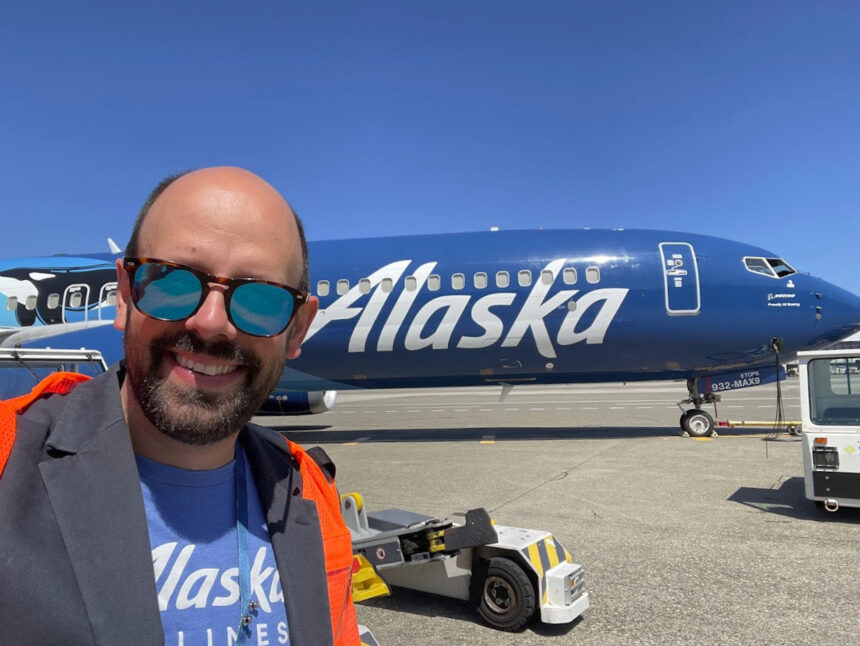
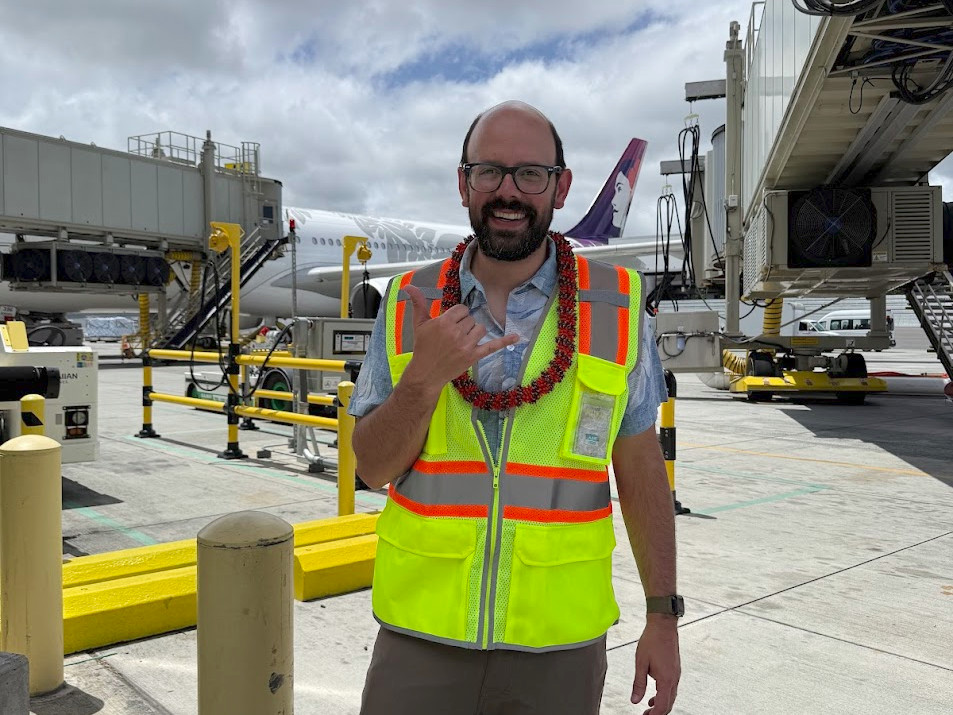
Ryan Spies, Alaska Airlines’ managing director of sustainability, isn’t a climate perfectionist. Yes, he drives an EV — but he also eats a relatively carbon-intensive cheeseburger now and then.
What matters more, he says, is when people work to drive larger-scale change: engaging in collective action, being mindful of who you vote for, and being intentional with your dollars. Spies also encourages consumers to contact companies directly with sustainability concerns.
“Any company I’ve been at, if a customer writes in with a complaint or a suggestion or a passionate plea, those make their way around inside a company,” Spies said. “That moves needles.”
It’s a philosophy that shapes how he approaches his day job leading sustainability efforts at Alaska — which operates nearly 1,500 daily flights across its mainline, Hawaiian Airlines and regional subsidiaries. Spies oversees climate reporting and public policy, employee engagement, operational efficiency and waste reduction.
A central focus is scaling up production and use of sustainable aviation fuel, or SAF. Alaska is a founding driver of the Cascadia Sustainable Aviation Fuel Accelerator, an initiative launched in January that aims to establish the Pacific Northwest as a global leader in SAF development.
Keep reading to learn more about Spies’ sustainability journey. His quotes have been edited for clarity and length.
What was the moment you realized you had to work in sustainability?
It was probably 20 years ago. I was a civilian engineer for the Navy, which wasn’t working on sustainability at all, and I saw “An Inconvenient Truth,” Al Gore’s film. I have always considered myself an environmentalist and someone who understands that we need to take care of the planet, but I didn’t have an idea of the stark crisis that we were going to be up against. That spurred me to leave my job, go back to school, get an MBA, and focus on strategy and how do we get corporations to do their part, and use the power of business to do good.
What’s your biggest worry when it comes to solving climate change?
A lot of people understand that it’s a big problem, but most people don’t feel empowered to do something about it. And look, I’m a father of three little kids. I understand that we all have day-to-day challenges, and these big existential challenges are not something that we can dedicate a lot of mind or time space to. So my biggest worry is that it just falls off of a level of importance. I don’t expect everyone to do something every day about it, but I would hope that we find a way to enable things like our government and governments around the world to tackle these big challenges.
What gives you the most hope for the planet?
I see how fast solutions to the climate crisis can scale and be implemented. Sixteen years ago when I started in this space in a real way, the promise of renewable energy was there, that it could save you money over the long term, but you wouldn’t quickly turn around and make money. Today I see the exponential growth of those solutions and the reduction in costs to make them the most affordable solutions. If you want to install new energy today, the absolute best choice is solar and storage. There’s no longer an economic argument against them.
If you could invent one climate solution overnight, what would it be?
It’s how do you make the most energy-dense battery in the world. If you can do that, you can pair it with clean renewable energy. EVs are a great example of where there’s been a lot of progress: They’re clearly an advantaged way to travel, and I love that, but in the airline business, we’re not close to that. It’s purely a physics problem. The densest batteries today are 300 watts per kilogram. Jet fuel is 14,000 watts per kilogram. It’s just not close.
Coffee with any climate leader, past or present — who do you pick?
I’ve had coffee with Al Gore, so I’ve already achieved that. It was at New York Climate Week. I was invited to this leaders’ breakfast and the surprise guest was Mr. Gore. It was great to be able to talk to him.
What’s an underrated sustainability solution that deserves more attention?
The idea of collective action is tremendously important — it takes so many people in different roles and organizations to actually move big things. Here in the Pacific Northwest, we started this collaboration with many of our partners called the Cascadia Sustainability Aviation Accelerator. We look at ourselves as a leader here in Washington state and the region, but we cannot solve the sustainable aviation fuel problem alone. We know that we need the state, we know that we need Boeing, we know that we need big corporates, we know that we need the universities.
What’s one metric you watch obsessively as a climate leader?
The price of oil is on all of our minds. And it’s a hard one because it’s so much of our costs at the airline, but on the other hand, the higher that price goes, the less demand there is and that’s probably a good thing for climate, for accelerating alternative solutions. I’m keyed in on that every day, and that was before the Strait of Hormuz closed, and will be long after it reopens. That’s a global metric that moves mountains.
The scope of the climate challenge is daunting – how do you approach this work?
Control what you can control, influence where you can, use your passionate voice, but also understand the pragmatic realities. Businesses are here to make money, and you’re not going to always win with a climate argument. When I think about influencing other leaders, other parts of the organization, to me it is about meeting them where they’re at and understanding what their priorities are and seeing how our priorities align. Ultimately, most folks are not thinking about climate and how their job can affect it. That’s what my job is.
What impact do you hope your work has in 20 years?
Meaningfully moving us away from a carbon-heavy lifestyle. We have the power to make these changes happen, and I think we’re all going to benefit from them. Even if you don’t care about climate or don’t think it’s going to affect your life, it will, and so how do we meaningfully improve the lives of every person on the planet and all the ones who are still to come. I hope my work plays a part in that.
Read the full article here