
Jeff Dean was a University of Washington graduate student in the 1990s, optimizing software compilers for object-oriented programming languages in a trailer wedged next to the old computer science building.
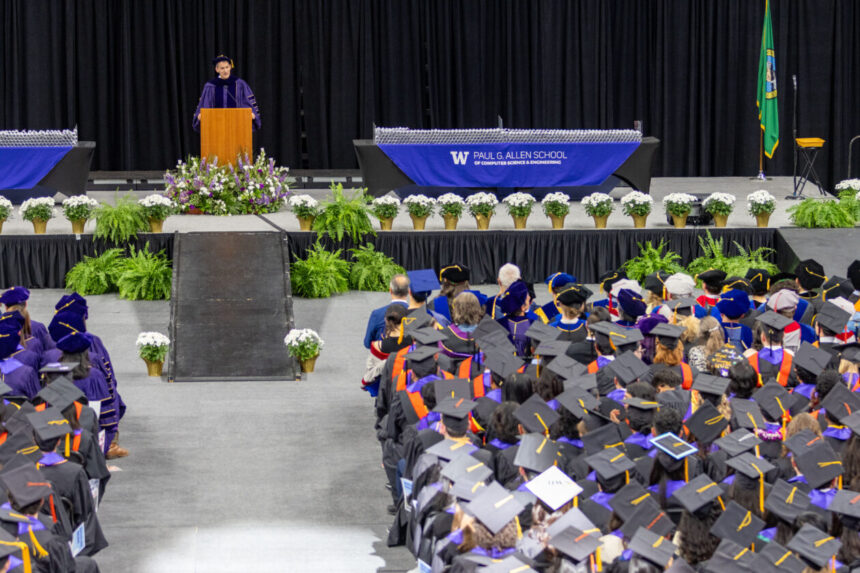
On Friday evening, Dean returned to the UW’s Allen School of Computer Science & Engineering as Google’s chief scientist and a co-leader of its Gemini AI models, with a message for graduates about the technology he and his colleagues have shaped — and to which many of them will soon be contributing at places such as Anthropic, Amazon, Microsoft, Google, and Nvidia.
“AI is an incubator for ideas,” he said, “not a substitute for human ingenuity.”
Speaking to a packed audience at the Allen School commencement ceremonies at UW’s Alaska Airlines Arena, Dean told the graduates that AI technologies may be able to draft code and summarize data, but can’t replicate their experiences, their ethics, or their sense of what’s worth building. Knowing what matters, he said, “can be your superpower.”
He didn’t address the state of the tech job market, but said they’re graduating at a pivotal moment, when the world needs their fresh perspectives and sharp thinking.
The Allen School’s choice of graduation speaker and his focus on AI might have been a risky proposition in a different setting. But given the audience, there were cheers and applause — not booing or jeering of the sort that has made headlines at graduations around the country this spring.
It also helped that Dean’s message was clear-eyed and balanced. He acknowledged the real concerns about the technology, telling the graduates that powerful advances carry responsibility.
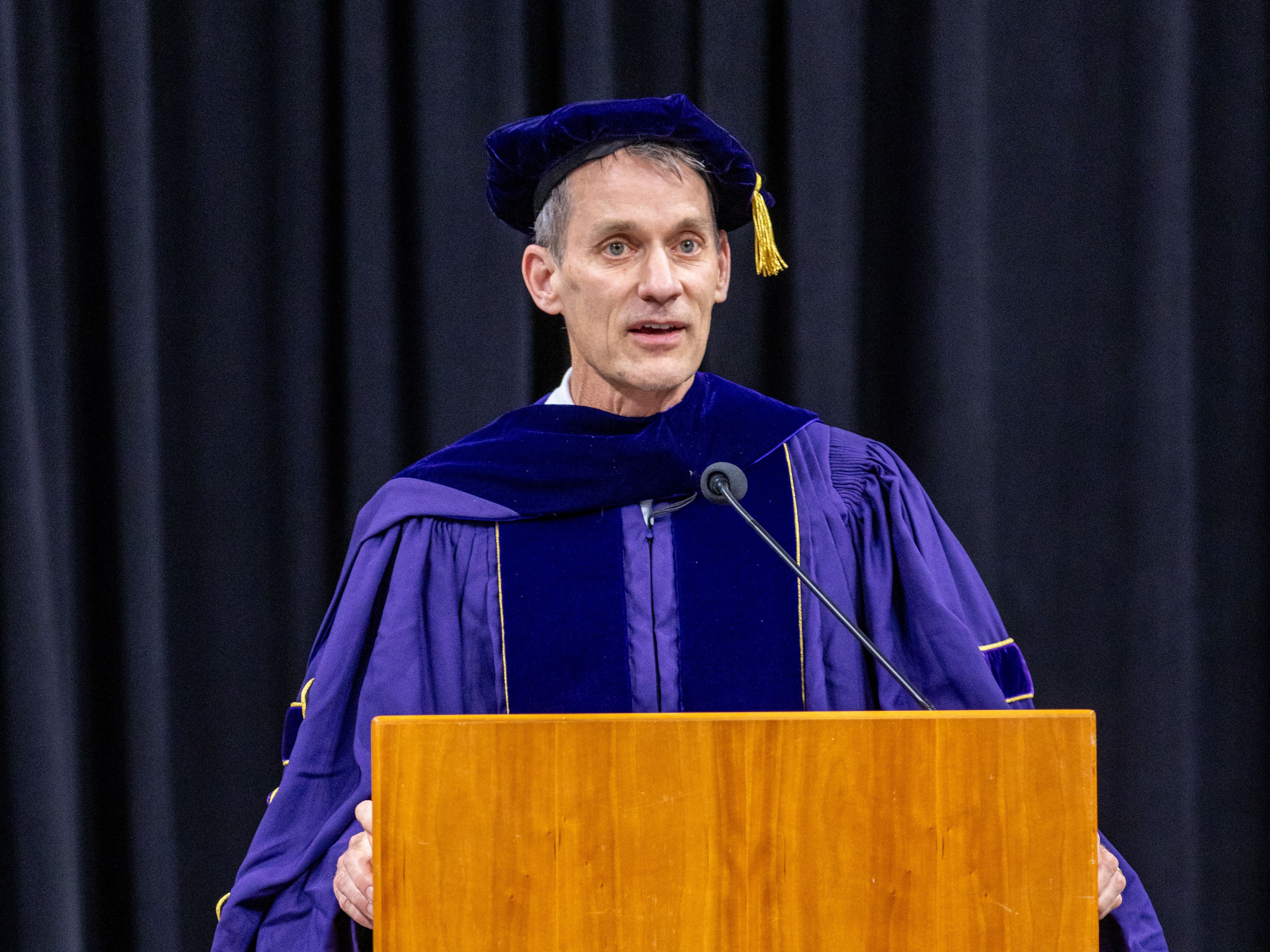
“We must intentionally design safeguards and ethical boundaries,” he said, “so technology serves the broader public good, not a select few.”
He also made the case for AI as a force for good, referencing its role in scientific and medical discovery and in forecasting natural disasters. For example, he cited the use of machine learning to predict the scope of severe flooding in Somalia (where he had lived for part of his youth because of his parents’ work in global health), helping to protect communities.
He pointed the graduates toward problems worth solving. In a paper he co-authored, he and eight others laid out 18 milestones where AI could make a difference: improving health care worldwide, giving every student an individual tutor, building tools to flag misinformation, speeding up scientific discovery.
‘Be patient and persistent’
Dean’s path to Google ran through the UW. He arrived in 1991 to study compilers under professor Craig Chambers, finished his Ph.D. in 1996, and joined Google three years later, when the company consisted of about 20 people working above a Palo Alto storefront.
On Friday he traced that arc for graduates who have studied in modern buildings named for Microsoft’s co-founders. Dean has fond memories of working in that cramped UW trailer, nicknamed “The Chateau,” alongside fellow students who became lifelong friends and colleagues.
Be intentional about the people you keep around you, and stay in touch, he told the graduates, predicting that the relationships and memories they made at UW would shape their futures, as well.
Dean and his wife, Heidi, were drawn to Seattle and the University of Washington in part by a brochure photo of Drumheller Fountain framed by Mount Rainier on a sunny day. He joked that it was eight months before they saw the mountain clearly.
Earlier, as a senior at the University of Minnesota, Dean had been interested in neural networks but found they weren’t equipped at the time to address real problems. He guessed that the answer was more computing power, and he was right — it just took a while and a lot more of it than he had ever imagined. The technology needed about a million times more processing power than computers had in 1990, he said, a threshold the field didn’t cross until around 2012.
The takeaway from that: “Be patient and persistent,” he told the graduates. Something you learned long ago, he said, may later let you do what wasn’t possible before.
Honors and recognitions
The UW’s Allen School awarded more than 800 degrees this year across its undergraduate, master’s and doctoral programs. The ceremony Friday evening drew a crowd of close to 7,500 graduates, families and faculty to the arena.
Magdalena Balazinska, the Allen School’s director, opened the ceremony by telling the graduates it felt like only yesterday the school had welcomed them. “I’m glad our future is in your energetic and passionate hands,” she said.
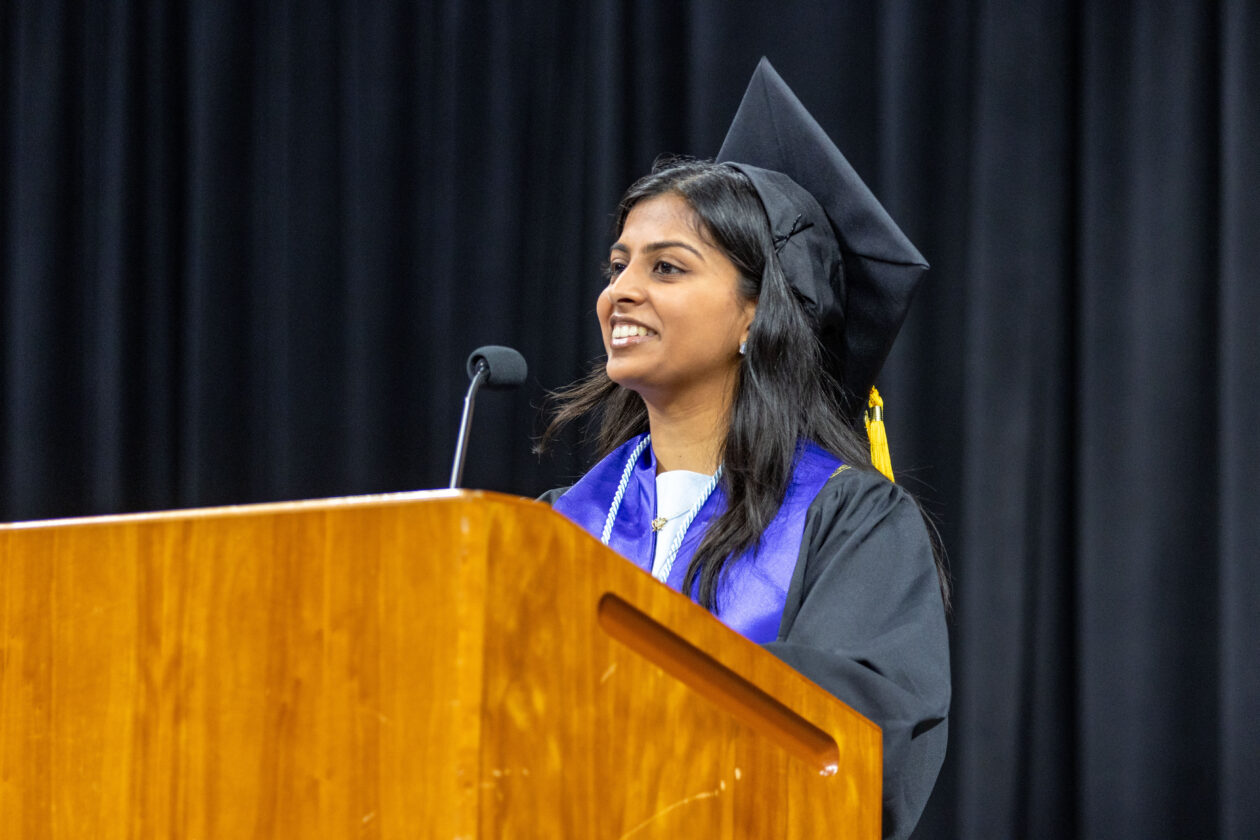
The ceremony featured the school’s first undergraduate student speaker, Vaishnavi Vidyasagar, a graduating senior from Sammamish, Wash. Computer scientists, she told her classmates, aren’t just writing code but opening doors. Her own capstone project, for example, was a tool to help people with misophonia navigate a world of overwhelming sound.
The evening also included recognition of two alumni with its Alumni Impact Awards: David Dawson, a 2006 graduate and co-founder of the recycling startup Ridwell; and Nodira Khoussainova, a 2012 Ph.D. graduate who co-founded the developer tool Streamlit and now leads the coworking platform Focused Space.
The Allen School handed out its end-of-year student and faculty awards at a separate ceremony earlier in the day, recognizing standouts in service, scholarship, teaching and thesis work.
Dean closed his remarks by urging the graduates to spend their careers on what counts — to use the new tools to amplify their ideas, and to work on problems that matter. Just as important, he said, is to “always treat people with respect and kindness, and have fun in what you do.”
Read the full article here