

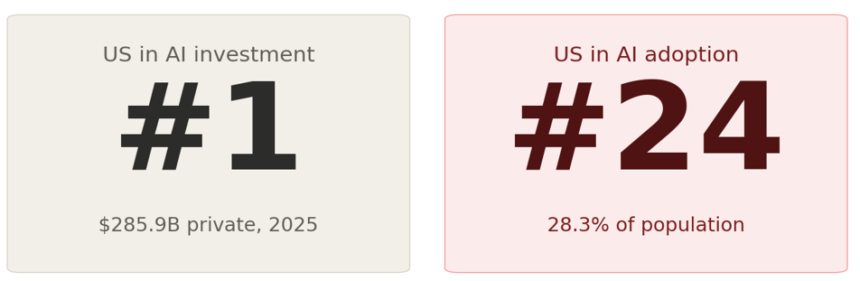
Stanford recently released the 2026 AI Index, the field’s annual physical. One finding stopped me cold: the country that leads AI development is not the country that leads AI adoption. I’ll come back to that. First, what is this AI Index?
The AI Index is the most rigorous data-driven portrait of where AI stands: a yearly checkup across technical performance, investment, the labor market, the environment, public attitudes, regulation, the US-China race, and more. Four hundred pages, twelve headline takeaways, and a measurement apparatus no other institution has matched.
Most of the 2026 takeaways confirm what we already know or strongly suspect. AI performance is climbing, investment is exploding, the China gap has closed, young software engineers are losing their jobs. Familiar territory.
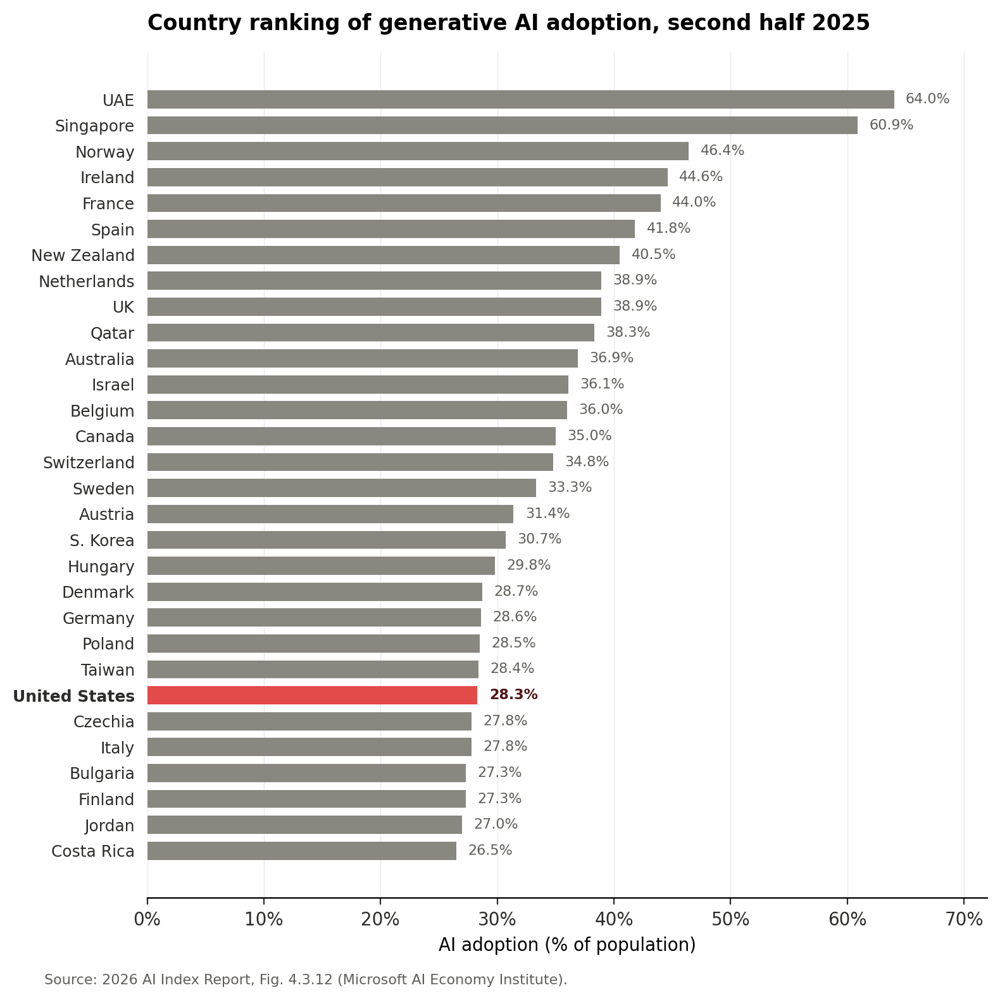
One number is surprising, though. The Index measures adoption (the share of a country’s population using generative AI tools) across two dozen economies in the second half of 2025. The leaders are not the countries you would guess.
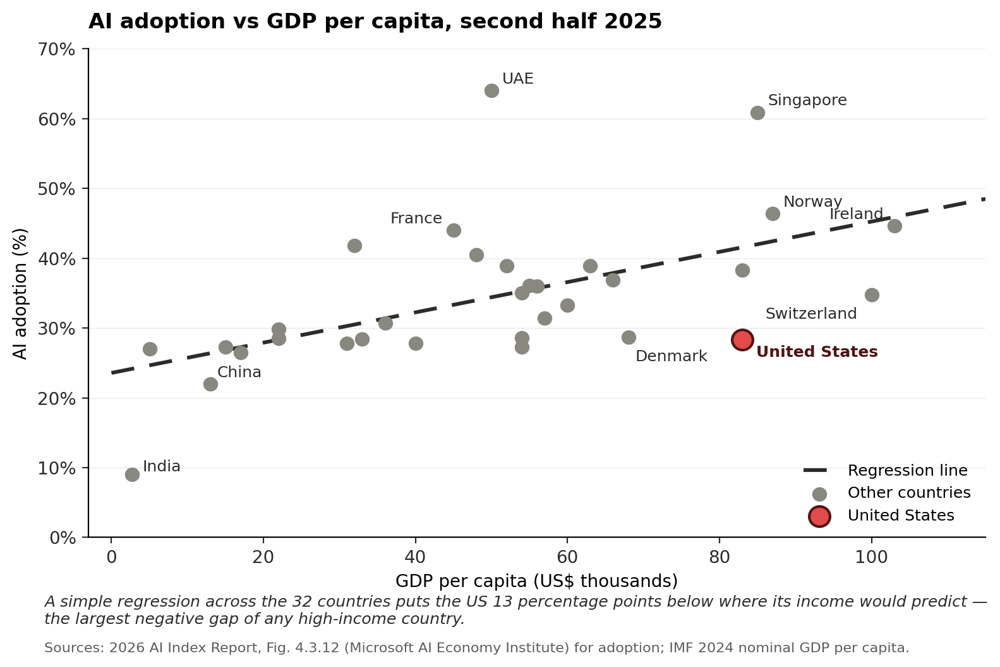
The United Arab Emirates tops the list at 64%. Singapore is second at 61%. Norway, Ireland, and France round out the top five. Adoption correlates strongly with GDP per capita: richer countries have better infrastructure and more knowledge workers whose jobs benefit from these tools. That makes intuitive sense.
The United States ranks 24th, at 28.3%. That shocked me.
The country ranking figure, below, provides the broader list.
Here is what makes the gap strange.
In 2025, US private investment in AI reached $285.9 billion, 23 times China’s and more than the rest of the world combined. Many of the leading models are trained in American labs. Even with talent inflows down 89% since 2017, US researchers still outnumber any other country’s by a wide margin. By every supply-side measure, we are the country that builds AI.
By the Index’s adoption ranking, we sit 23 places behind the UAE, just ahead of the Czech Republic.
The gap is not about ease of access. Americans can use the same tools, on the same day, for the same price (usually zero) as anyone else.
The AI adoption vs GDP per capita scatterplot, below, plots each country against its income. The US sits about 13 points under the trend line, the largest gap of any wealthy country.
The rest of the report makes additional important points with some staggering statistics—for instance, a jump in AI performance on cybersecurity benchmarks from 15% to 93%.
The bad news
Seven findings give cause for concern.
Energy. Training and inference now consume gigawatts of electricity. Grok 4’s training run emitted 72,816 tons of CO2, the equivalent of 17,000 cars driven for a year, and global AI data center capacity reached 29.6 gigawatts, roughly New York State at peak demand.
Talent flight. The number of AI scholars relocating to the US has dropped 89% since 2017, with an 80% decline in the past year alone.
US-China parity. The performance gap between the top American and top Chinese models has closed to 2.7 percentage points. China leads on publication volume, patent output, and industrial robot installations, aligned with what Cady and I predicted back in 2019.
Transparency collapse. The Foundation Model Transparency Index grades the major developers on how much they reveal about their models, from training data to downstream use. After two years of gains, the average fell from 58 to 40 in a single year. The most capable models disclose the least.
Entry-level squeeze. Employment among US software developers aged 22 to 25 has fallen nearly 20% from its 2022 peak. One in three organizations expects further workforce reductions over the coming year.
Students lead but schools lag. Four in five US high school and college students now use AI for school-related tasks. Half of middle and high schools have no AI policy, and only 6% of teachers say their school’s policies are clear.
Public ambivalence. Global optimism about AI rose to 59%, but only 33% of Americans expect AI to make their jobs better, and only 31% trust their government to regulate it, the lowest figure of any country surveyed.
The good news
Four findings are positive.
Technical performance. Frontier models now meet or exceed human performance on PhD-level science and competition mathematics, and the success rate of agents on cybersecurity benchmarks jumped from 15% in 2024 to 93% in 2025.
Investment. Global corporate AI investment hit $581.7 billion in 2025, up 130% year over year, with generative AI capturing nearly half of all private funding.
Science. AI-related publications in the natural, physical, and life sciences rose 26% to 28% year over year. AI ran its first end-to-end weather forecasting pipeline, and astronomy built its first foundation model.
Medicine. Clinical-note tools cut physician note-writing time by up to 83% across multiple hospital systems.
The Index is at its most useful when it surfaces a surprise. This year, that finding is the diffusion gap: the country that builds AI is not the country that uses it.
Why the gap? The report doesn’t say. But the adjacent findings hint at an answer. American workers expect AI to make their jobs worse. American voters distrust the government that would regulate it. American firms are deploying it more slowly than firms in China or Europe. Ironically, the country that pioneered generative AI is underutilizing it. Number 24. Sheesh.
Read the full article here