


For much of the past year, the narrative surrounding Washington state’s business climate has taken a decidedly negative turn.
Business leaders have criticized a wave of new taxes approved by lawmakers. High-profile companies have announced expansions elsewhere. Entrepreneurs have questioned whether Washington remains as welcoming to innovation as it once was, prompting Gov. Bob Ferguson to launch a new Economic Development Council aimed at strengthening the state’s competitiveness.
But a new national ranking released Thursday complicates that narrative.
Washington climbed three spots to No. 11 in CNBC’s annual America’s Top States for Business rankings, up from No. 14 last year, suggesting that many of the state’s underlying competitive strengths remain intact even as debate over its business climate has intensified.
That’s the good news. The bad news: Just four years ago, Washington ranked No. 2 in the same survey. In 2017, the state was No. 1
Certainly, Washington is at a crossroads when it comes to how it thinks about its business community. The CNBC ranking and the big fluctuations over the past four years speak to the seesaw-like narrative that has taken shape.
The business climate also has been front-and-center in GeekWire’s recent coverage.
Washington lawmakers approved billions of dollars in new taxes during this year’s legislative session, including new taxes affecting many technology companies.
Ferguson subsequently created the Economic Development Council composed of leaders from companies including Microsoft, Amazon, Boeing and T-Mobile to identify ways to strengthen the state’s economy amid growing concerns about competitiveness. (GeekWire contributing columnist Charles Fitzgerald questioned why the council did not include anyone from the startup community in his recent piece: Governor’s new economic council snubs startups, forgets AI).
We also recently traveled to Cleveland to examine why Ohio has emerged as one of the country’s fastest-growing destinations for business investment and technology jobs. State leaders there have aggressively positioned Ohio as an alternative to coastal technology hubs, touting lower costs, business-friendly policies and major investments in manufacturing, semiconductors and artificial intelligence infrastructure.
That strategy appears to be paying off.
Ohio claimed CNBC’s top spot this year, overtaking last year’s winner to become America’s Top State for Business in 2026. It has been an historic climb for the Buckeye state, which ranked No. 30 in the inaugural survey in 2007 and just cracked the top 10 last year.
One of GeekWire’s key takeaways from our visit to northeast Ohio is that the entire community is unified, rowing in one common direction, from Gov. Mike DeWine to real estate developers to entrepreneurs to philanthropic organizations.
“I don’t give advice to other areas,” DeWine told us on our recent visit. “But my advice to people is, come to Ohio. Come work in Ohio. You will not find a better place, better people, quality of life. Cost of living is low compared to the two coasts.”
The ranking also comes as several prominent Washington employers have announced significant investments outside the state. Starbucks recently unveiled plans for a major corporate expansion in Nashville, while aerospace supplier Janicki Industries said it will build a large new manufacturing campus in Montana, fueling concerns among some business leaders that Washington is becoming a more difficult place to grow.
At the same time, CNBC’s methodology highlights many of the advantages that have long made Washington one of the country’s leading innovation economies. Here’s how Washington ranked per CNBC:
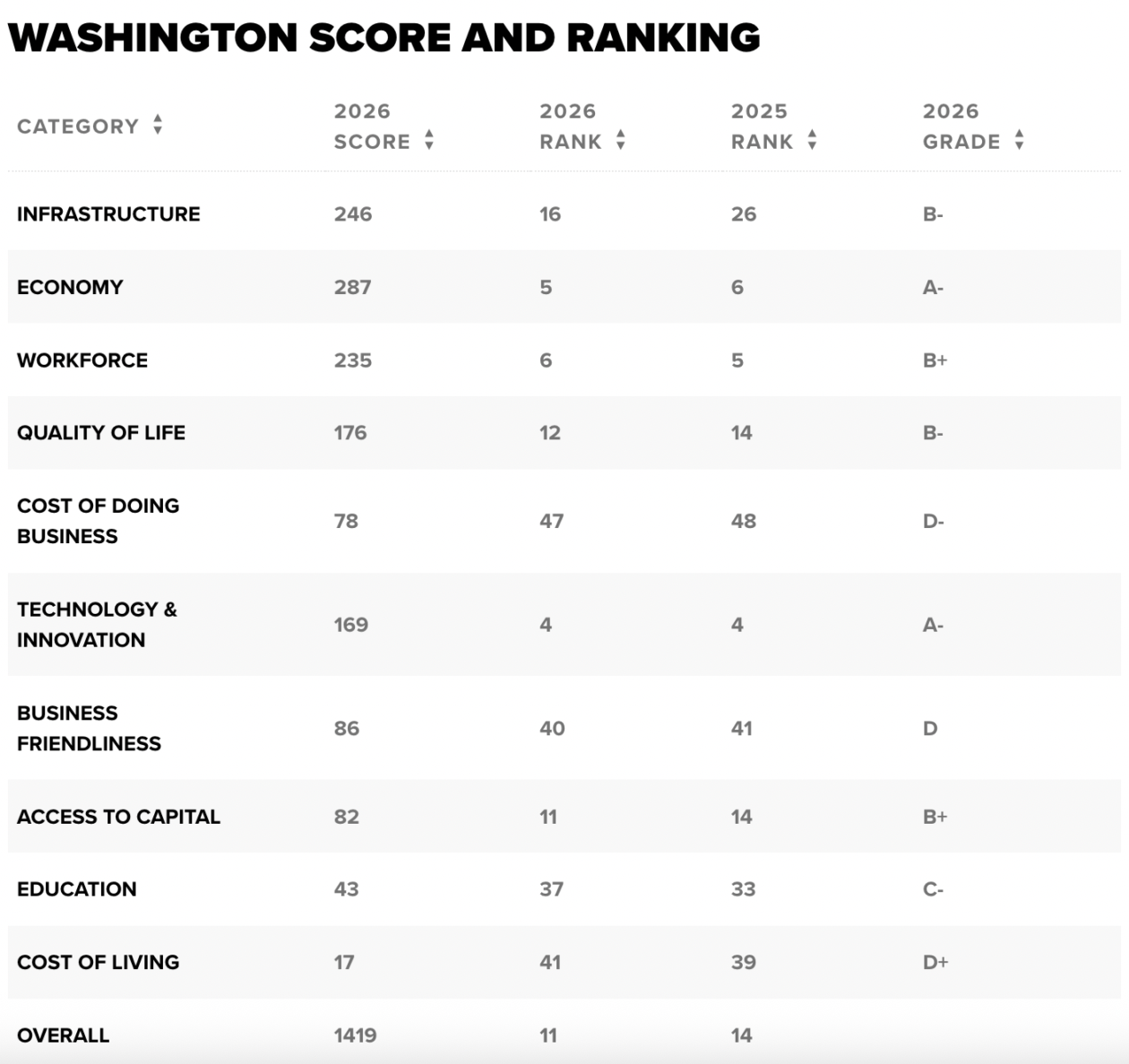
The network evaluates states across 10 categories using 138 metrics, including workforce, infrastructure, economy, technology and innovation, business friendliness, education, cost of doing business and quality of life. The methodology is updated annually to reflect the factors companies say matter most when making investment decisions.
While Washington continues to face challenges related to business costs and taxes, it remains home to one of the nation’s deepest concentrations of technology talent, world-class research universities, global companies including Microsoft and Amazon, and a robust startup ecosystem — strengths that continue to score well in CNBC’s analysis.
The results also underscore how different rankings can produce different conclusions depending on what they measure. The nonpartisan Tax Foundation, which focuses specifically on state tax policy, ranked Washington 45th in its 2026 State Tax Competitiveness Index, citing the state’s gross receipts-based Business & Occupation tax, taxation of business inputs and recent changes to its capital gains tax.
Seattle also recently declined in a new ranking of the best places in the U.S. to attract foreign businesses and investment. The fifth annual list compiled by British newspaper Financial Times and stock market index Nikkei ranked Seattle 13th among 95 U.S. cities — a drop of 11 places from last year’s second-place position.
Together, the rankings illustrate the complexity of evaluating a state’s business climate.
Washington continues to enjoy many of the assets that have made it one of the nation’s leading centers for technology and innovation. At the same time, business leaders have become increasingly vocal that higher taxes and rising costs could erode those advantages over time if policymakers fail to address competitiveness.
Read the full article here