
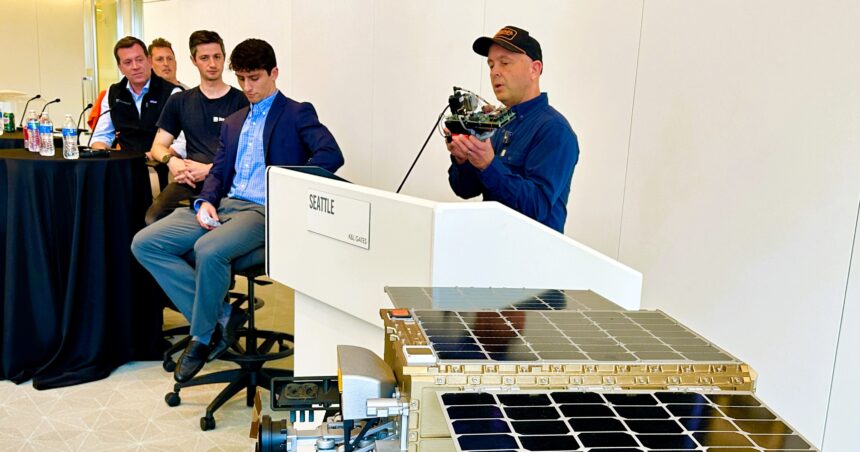
Four founders of companies on the tech frontier got together this week at a Seattle conference for a show-and-tell about the hardware at the heart of their businesses. And like any good show-and-tell, their talks touched on strategy as well as gadgetry.
For example, consider the laser-powered weed zapper pioneered by Seattle-based Carbon Robotics. The LaserWeeder system takes advantage of optical sensors and artificial intelligence to identify and target the weeds among the crops as the robotic rig is pulled through a field.
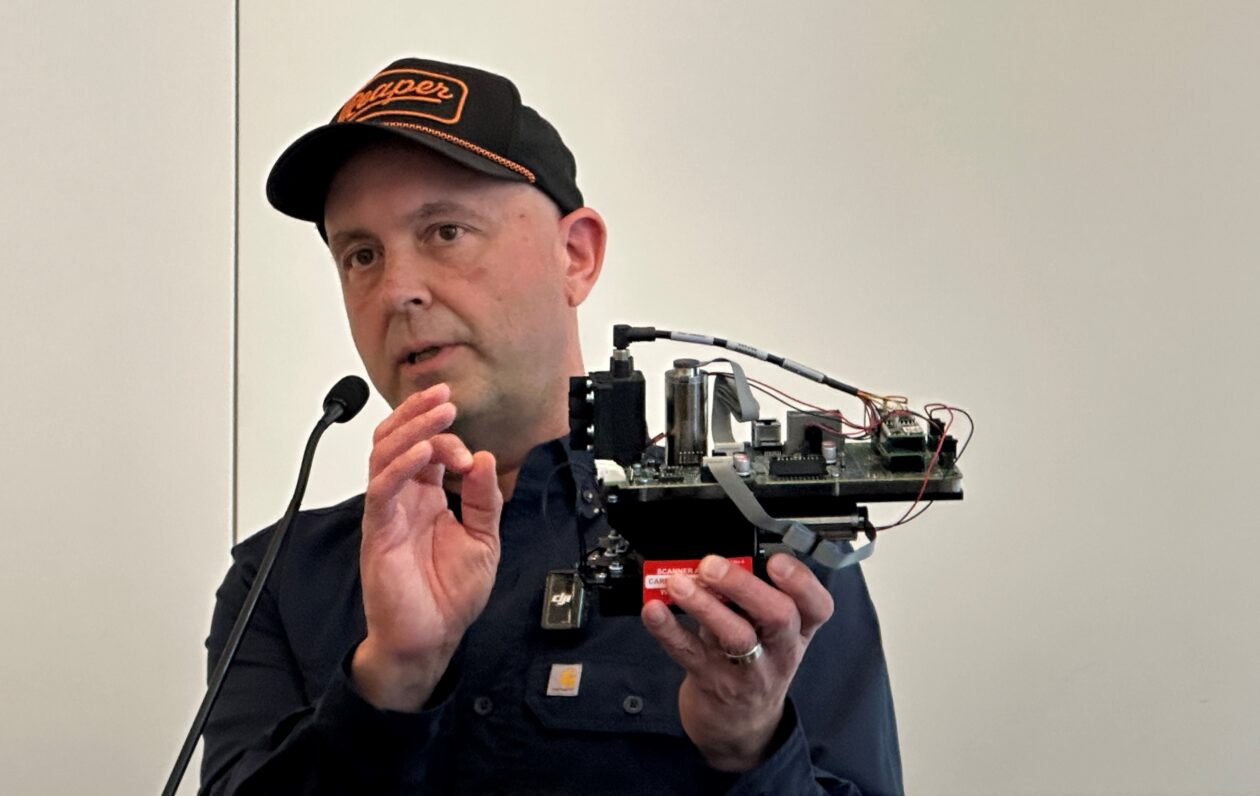
Carbon Robotics’ founder and CEO, Paul Mikesell, held up one of the LaserWeeder’s scanners during Monday’s DeepTech session at the downtown office of K&L Gates.
“We have it set up so this camera can see exactly what the laser shooting this way is going to hit, and every time we turn on that laser, the same pixel area in the camera is going to explode and blow up,” he said. “This device reminds me of a lot of science and technology that we had to tackle, but also, there’s a lot of pain that went into this thing.”
The company’s engineers had to figure out how to target weeds precisely based on imagery that was distorted by the camera’s viewing angle. “It’s a pretty incredible feat to get that right, and once we got it right, we’re just banging off them all the time,” Mikesell said.
Mikesell said he’s often asked about his strategy for selling LaserWeeders through farm-implement dealerships. “We decided to go direct every time, all the time,” he said. “And so we have a global team of sales reps and service support people. What that means is, we maintain the customer relationship. We know what things are being used for, how well it’s working, what are their challenges. And the customers know how to get a hold of us directly instead of going through a dealership.”
He’s looking forward to the day when artificial intelligence can speed up the process of hardware design. “I’m surprised by the lack of an AI tool in there, but I think it’s also because, you know, software engineers wrote the software that made the AI, so they’re much more comfortable with it,” Mikesell said.
“We actually did hook Claude up to an oscilloscope and got it to produce firmware that was proving out what we needed,” he said. “So I think that’s just going to continue to come.”
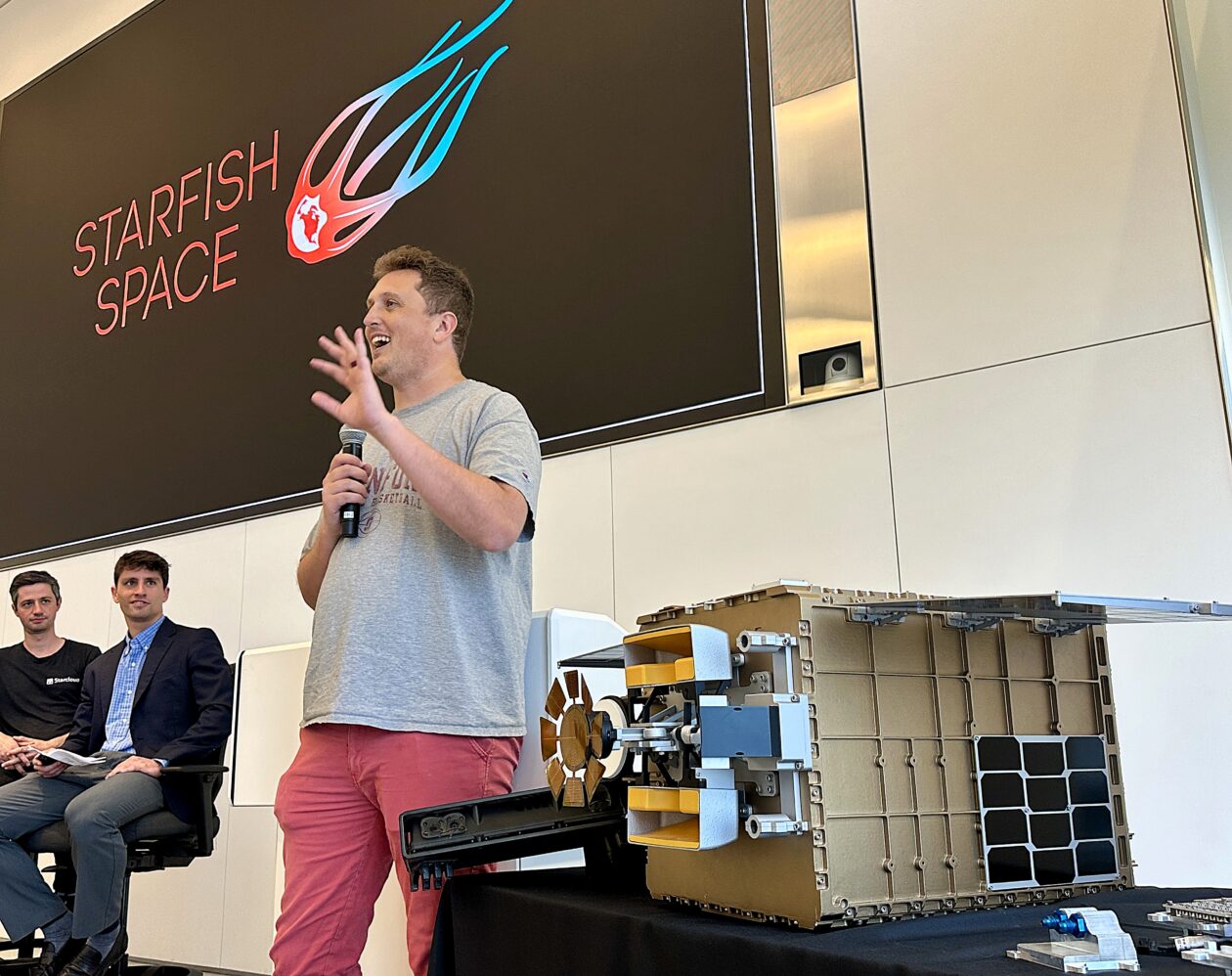
Starfish Space co-founder Austin Link’s gadget for the show-and-tell was too big to lift off the display table. It was an engineering model of Starfish’s Otter Pup spacecraft, one of which is currently in the midst of an orbital satellite docking test.
“We actually ran a pretty exciting test over the weekend, which I can’t tell you about yet,” Link said.
Otter Pup is designed to prove out technologies that will be used on Starfish’s full-scale Otter spacecraft for inspecting or maneuvering other satellites in orbit. “Humans have done this before, but every time we’ve done it before, it’s really expensive,” Link said. “You look at a Northrop Grumman satellite that did a similar mission. They made $65 million by extending the life of a satellite. It cost $400 million to do it.”
Starfish aims to use innovations in computer vision and robotics to make satellite docking more affordable. That means the Tukwila, Wash.-based startup has to do more with less.
“This satellite has just a single thruster on board, and the force that that thruster creates is the equivalent of a house fly sitting on your hand,” Link said. “It’s a tiny amount of force, so you have to apply it very thoughtfully over time. You have to predict what’s going to unfold with the physics and ultimately come together and dock. And that’s our big challenge as a company, not just with a demonstration satellite, but eventually with our full-size Otter.”
Overland AI builds autonomous off-road vehicles, including a 3,000-pound tactical vehicle that can transport supplies, drones or even anti-drone weapon systems for warfighting units.
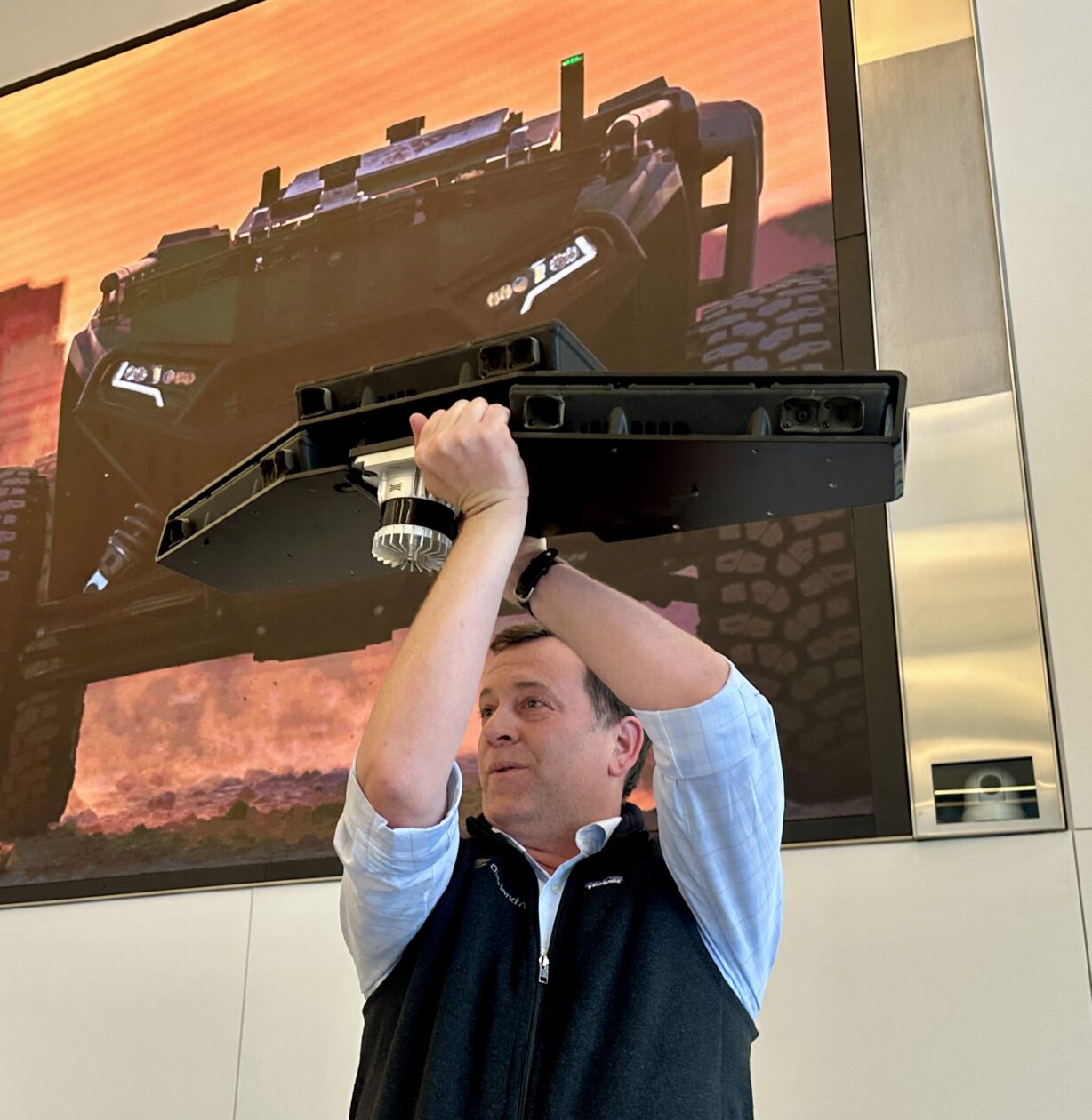
“It’s not super-easy to get one in this room, but I wish I could have brought it,” said Byron Boots, co-founder and CEO of the Seattle-based startup. “Instead, what I did was rip the sensor pod off one of these vehicles.”
The sensor pod is equipped with stereo cameras and a lidar ranging system, all of which are hooked into an onboard computer. “This is from something called our SPARK Kit, which allows you to take any vehicle and make it autonomous,” Boots said. “It actually hangs up over the head of where someone would sit on a vehicle like this.”
Even though “AI” is part of the company’s name, Overland AI’s focus has widened from just writing the software to building the hardware as well.
“In order to move fast, we decided we just needed to do that ourselves and own that full vertically integrated stack,” said Boots, who is a professor of machine learning and robotics at the University of Washington as well as a startup CEO. “If you do that, you can then literally hand this robotic system with an autonomous stack on it to a user, and they can just start using it. You don’t have to wait for someone else to integrate with you.”
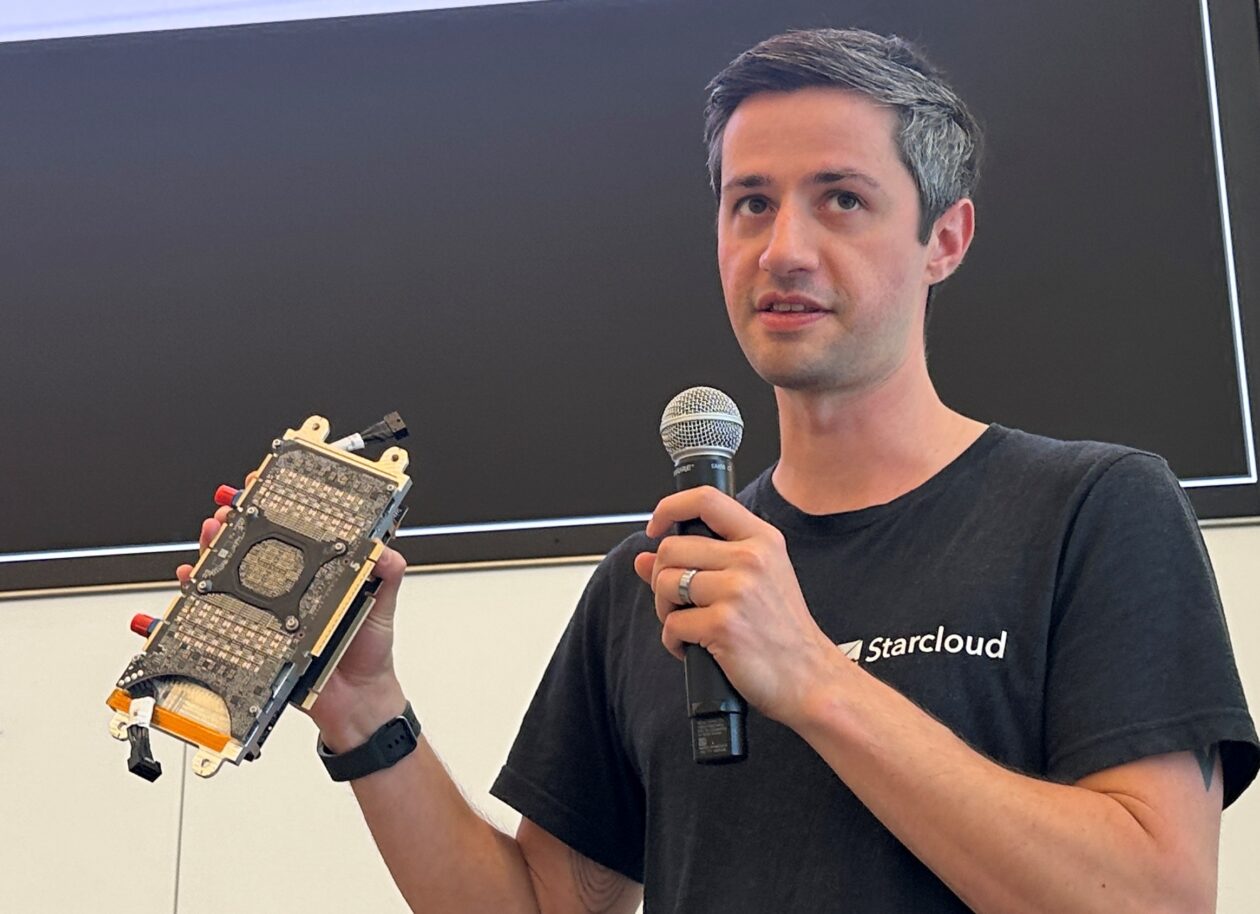
Redmond, Wash.-based Starcloud made its mark at the intersection of AI and space operations last year when it became the first company to train a large language model in Earth orbit. For this week’s show-and-tell, the company’s co-founder and chief technology officer, Ezra Feilden, brought an Nvidia H100 GPU — the same type of AI chip that was used for last year’s in-space demonstration.
“It’s very high power density. These GPUs were designed to sit and have a nice easy life inside a data center. They were not designed to be strapped to a rocket and launched into the vacuum of space, and then be run for five years without any maintenance or any TLC,” Feilden said. “So, that’s part of what we do at Starcloud. We ruggedize GPUs and other IT hardware such that they survive the launch, and then they can operate continuously in space without any mechanical intervention.”
Orbital data centers are attracting a rising tide of buzz because they could get around some of the big problems created by the rapidly growing hunger for AI data processing capacity: for example, limits on available electrical power, and concerns about land and water use.
Data processing in space brings its own challenges, however. How many solar-powered satellites will be required to handle the load? How will they be connected? And how will they be able to get rid of the waste heat produced by all those high-powered AI chips? Feilden and his colleagues at Starcloud are working to address those challenges.
Feilden said his company is scaling up operations at a new facility in Woodinville. “We’ll be deploying dozens of satellites that we build from that facility in the next couple of years, scaling up to thousands of satellites per year, which is the number that we need to hit to have a meaningful impact on the terrestrial data center industry with what we’re doing,” he said.
Starcloud isn’t the only company with big ambitions for orbital data centers. SpaceX, which is just days away from the world’s biggest initial public offering, envisions putting a million data center satellites in orbit. But SpaceX could be as much of a partner as a competitor. Last month, Starcloud struck a deal to use SpaceX’s Starlink mini laser terminals on its own satellites. And Starcloud is counting on new launch vehicles, including SpaceX’s Starship mega-rocket, to drive down the cost of putting satellites in orbit.
“We strongly believe that’s happening very soon,” Feilden said. “This decade, certainly.”
Starfish Space’s Austin Link was intrigued by that perspective. He noted that Feilden and his colleagues are working with a business model that assumes launch costs will decline significantly. “We assume that launch cost is what it is today, and we don’t make any changes in our models when we’re designing products,” Link said. “It’s a really interesting contrast.”
The schedule of events for Deep Tech Week Seattle continues through Friday.
Read the full article here