
SpaceX’s initial public offering is likely to boost the company’s valuation to $1.77 trillion, promote CEO Elon Musk to trillionaire status — and benefit the Seattle area’s space community as well.
The $75 billion IPO, which will add SpaceX to the Nasdaq stock exchange on Friday, is expected to be the biggest initial public offering in history. It’ll provide more capital for expanding SpaceX’s satellite networks and putting the company’s Starship mega-rocket into operation. Shareholders, including some of the hundreds of SpaceX employees in the Seattle area, could get a golden opportunity to cash in.
There could also be a payoff for Pacific Northwest space ventures that are banking on the lower launch costs and higher payload capacity SpaceX is promising to deliver.
“The reality is that SpaceX is the elephant in the room — and for a real reason, which is that they’ve got the lowest cost of launch and will continue to do so when Starship is up and running,” said Brendan Wales, general partner at Fuse, a Seattle-based venture capital firm. “So, whether SpaceX is successful or not, it is very impactful on Seattle startups.”
Those startups include a few that have received funding from Fuse, such as Redmond-based Starcloud, which aims to send a constellation of data center satellites into space; and Bothell-based Portal Space Systems, which is developing highly maneuverable spacecraft designed to inspect, service or deorbit other satellites.
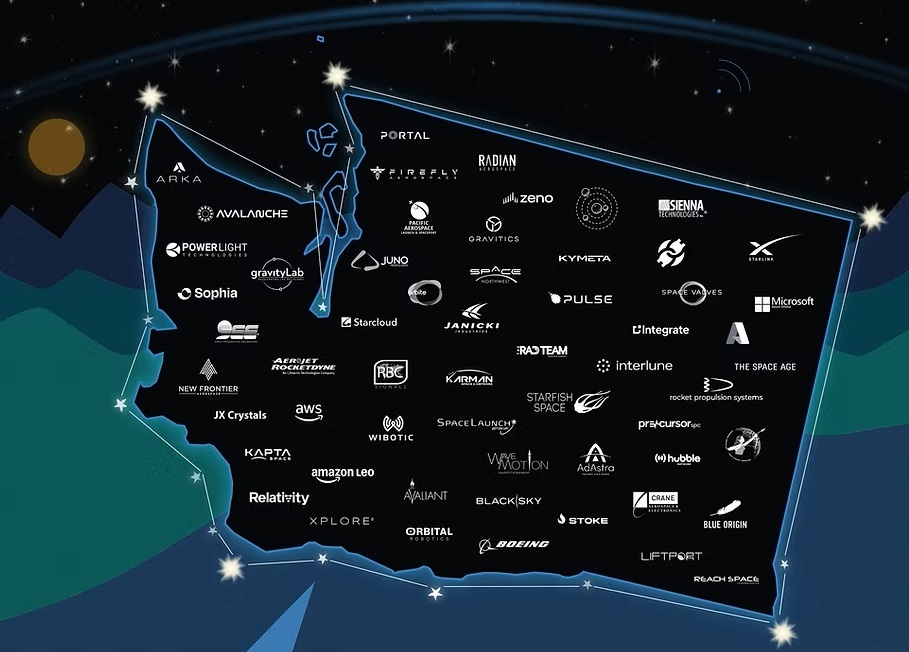
The list of Washington state’s space ventures doesn’t stop there: Space Northwest, a Seattle-based space industry association, says more than 75 space companies call the Evergreen State their home.
SpaceX connects with the Seattle area
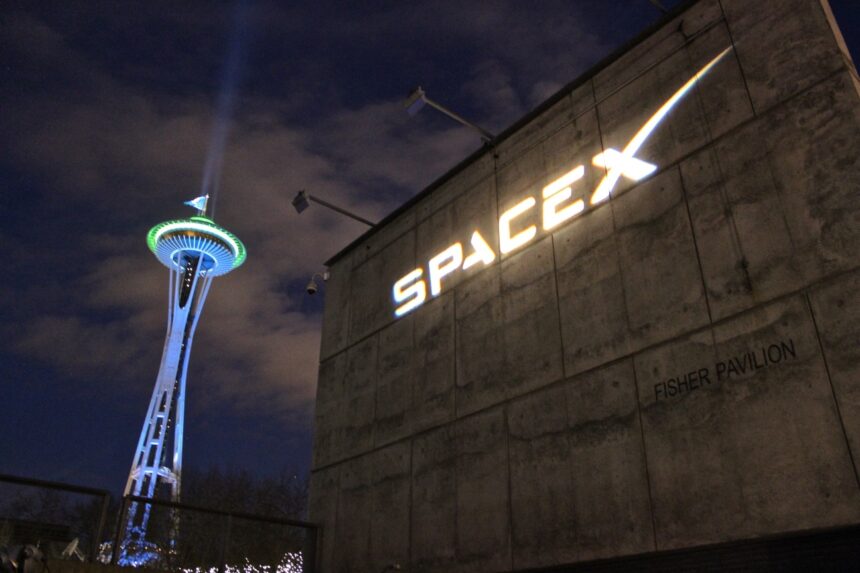
Even SpaceX is on Space Northwest’s map, by virtue of the company’s satellite production facility in Redmond. Back in 2015, Musk told a Seattle Center audience consisting primarily of potential employees that the satellite operation would be set up in the Seattle area instead of Southern California because “a lot of you guys, it seems, don’t want to move to L.A.”
Since then, SpaceX’s Redmond campus has been responsible for building nearly two-thirds of the world’s active satellites in orbit, and according to SpaceX’s IPO filing, the factory continues to turn out 70 satellites per week for its Starlink broadband internet constellation. With more than 12 million subscribers, Starlink generates more than half of SpaceX’s revenue and is the only one of the company’s three business segments to turn a profit.
SpaceX hasn’t said how many of its employees work in Redmond, although informal estimates range from 800 to 2,000. It’s even less clear how many of those employees will cash in on stock options. For what it’s worth, comments posted to Reddit suggest there won’t be enough of an impact to skew the Seattle area’s already-overheated housing market. “I think it’s going to be a big nothingburger,” one commenter wrote.
Starlink was just the first step in Musk’s strategy to turn SpaceX into a satellite company as well as a launch company. Most recently, Musk has laid out a vision for sending a million satellites into orbit to process data for artificial intelligence. But the IPO filing suggests that Redmond won’t be getting the biggest piece of that action: Instead, SpaceX says its operation in Bastrop, Texas, will be put in charge of producing AI compute satellites.
Seattle-area ventures connect with SpaceX
The impact of this week’s IPO won’t be limited to SpaceX and its shareholders, said Stan Shull, who monitors the Seattle area’s space industry as the founder and managing director of Alliance Velocity.
“A successful SpaceX IPO is likely to further accelerate the space industry, driving even more investment into the sector,” Shull said in an email. “Also, we may see a new round of now-wealthy SpaceX employees leave and start new entrepreneurial space ventures, including here in the greater Seattle area. Finally, the significant funds that SpaceX is raising with this IPO will help to ensure their success developing the Starship rocket, which some space companies are banking on for their own business models.”
For example, Marysville-based Gravitics is developing the orbital equivalent of aircraft carriers for customers including the U.S. Space Force. The largest of those cargo-carrying spacecraft are designed to ride into space on SpaceX’s Starship or other heavy-lift rockets.
“SpaceX gets you to space. Gravitics makes it possible to operate once you’re there,” Gravitics CEO Colin Doughan said in an email. “The IPO confirms the launch layer is durable enough to build on. We’re executing on the logistics layer above it: more mass per mission, lower cost per kilogram, designed for the way commercial operators are actually flying now. We are thrilled for our friends at SpaceX and see this as good for the industry overall.”
Jason Andrews, the co-founder and CEO of a spaceflight training venture called Orbite Space, acknowledged that he and fellow founder Nicolas Gaume had SpaceX’s Starship in mind when they created their Seattle-based company.
“Nicolas and I did indeed start Orbite because of the revolution Starship represents — a radical reduction in price, increase in frequency, and overall improvement in the client experience,” he said in an email. “As outlined by SpaceX, one of their ultimate missions is human expansion to the moon and eventually Mars, which is a good thing for the prospect of human spaceflight across the range of customers: governments, businesses and consumers. … Human spaceflight will soon be available to a much wider swath of humanity, and we are excited to play a small part in making that happen!”
Starcloud has already struck a deal to use SpaceX’s laser-based communication system on its own data center satellites, and plans to have Starship send its Starcloud-3 satellites into orbit when SpaceX is ready to take on commercial customers.
That may take a while, Shull said. “Initially, SpaceX is likely to prioritize Starship launches for its own space business ambitions and commitments. These include next-generation Starlink deployments, contracted flights for NASA’s Artemis moon program, its ambitious orbital AI data center plans, and possibly even test flights to Mars,” he said. “While I think Starship can and will be a total game-changer for the space industry, companies whose business models are largely or entirely reliant on ultra-low-cost Starship availability might have to bide their time or compete for early flight opportunities.”
SpaceX currently dominates the global launch industry — and if it continues to do so in the post-IPO era, Shull said the company may not feel the need to reduce its prices as rapidly as potential customers hope. Heightened competition from Seattle-area launch companies like Jeff Bezos’ Blue Origin space venture (for heavy-lift payloads) and Stoke Space (for medium-lift payloads) could change the equation.
The excitement generated by SpaceX’s IPO, and by lower launch costs, could also spark a new wave of companies doing things that sound like science fiction today. For example, one of the startups in a recent Y Combinator cohort, Galactic Resource Utilization Space, aims to build the first hotel on the moon.
Wales, the startup investor at Fuse, acknowledges that some of the business plans inspired by SpaceX’s IPO may never get off the ground. But the way he sees it, that’s totally normal.
“That type of thing happens when you’ve got a lot of capital flowing into a market, and then maybe it pulls back and there’s less of the wild stuff,” he said. “But I like these bubbly moments, because it allows for creativity. Some things will survive, and there are going to be things that could change the world.”
Read the full article here