

Qualcomm recently unveiled its Snapdragon Wear Elite platform, a new processor designed to bring more AI processing directly onto wearable devices.
Wearables have long been limited by battery life, heat, and processing power. Built on a 3-nanometer process, the new platform is designed to improve efficiency while providing the performance needed to run more advanced AI workloads directly on the device rather than in the cloud.
One of its most notable features is a dedicated neural processing unit (NPU) that can run large AI models locally, enabling wearables to perform more tasks without relying on cloud processing.
It also supports 5G RedCap, Wi-Fi, Bluetooth 6.0, and satellite messaging. Together, those capabilities help address many of the limitations that have held wearables back. Whether consumers ultimately benefit will depend more on how device makers implement it than on Qualcomm’s silicon alone.
Let’s talk wearables this week. Then, we’ll close with my Product of the Week, a wearable device I use regularly that has become more useful than my smart glasses.
What Better Hardware Makes Possible
Before looking at the potential pitfalls, it’s worth considering what this hardware makes possible. By moving more AI processing onto the device, wearables can reduce the latency, connectivity dependence, and battery drain associated with constant cloud communication. That makes a wider range of AI-powered features feasible on smaller devices.
Location awareness could also improve. More precise positioning may help wearables determine a user’s location more accurately, even in dense urban environments, improving navigation, health monitoring, and other context-aware applications. Rather than simply recording a high heart rate, on-device AI could combine biometric, environmental, and activity data to determine whether a notification is actually meaningful before alerting the user or contacting emergency services.
Better storage, wireless connectivity, and processing could also make wearables more capable as standalone devices for music, communications, and navigation without requiring a nearby smartphone. Satellite connectivity may also improve emergency communications and location sharing in areas without cellular coverage.
Ultra-wideband (UWB) support could also expand digital key functionality already available in some vehicles, allowing compatible wearables to unlock and start a car without removing a phone or key.
Ultra-wideband technology can allow compatible smartwatches to unlock and start supported vehicles without using a physical key or smartphone. (AI-generated image)
The added processing power could also expand the use of enterprise applications such as body-worn cameras, industrial safety equipment, and other wearable devices that rely on on-device AI.
When Great Technology Isn’t Enough
Despite those advances, I’m cautious. The technology industry is full of impressive engineering that failed because companies focused more on specifications than on the overall user experience. If this new platform is going to succeed, its hardware partners will have to avoid repeating those mistakes.
Consider IBM’s early smartphone efforts, most notably the Simon Personal Communicator, as well as its modular PC concepts. IBM excelled at engineering but often designed products that appealed more to engineers than to everyday consumers. The technology was innovative, but the devices were bulky, the interfaces were complicated, and the overall experience failed to attract a broad audience.
Dell repeated many of the same mistakes with products like the Dell Digital Jukebox and later the Dell Streak and Aero smartphones. The company focused on matching competitors’ specifications rather than delivering a complete user experience. Strong hardware alone wasn’t enough to overcome weaker software and ecosystem support, and Dell abandoned the products rather than continuing to refine them.
Microsoft provides another cautionary example. The company had the resources to compete with Apple’s iPod, but early Zune products emphasized features such as restrictive digital rights management and peer-to-peer sharing instead of creating a simpler music experience. By the time Microsoft released the much-improved Zune HD, consumer interest had largely shifted elsewhere, and the company eventually exited the market.
Why Wearables Still Frustrate Mainstream Buyers
Those same lessons apply to today’s wearables. The technology continues to improve, adding better sensors, wireless connectivity, and increasingly capable on-device AI. Yet many wearable products still struggle to gain broader consumer acceptance because manufacturers often prioritize technical capabilities over the overall ownership experience.
First, appearance matters. Unlike a smartphone that spends much of its life in a pocket, a wearable is constantly visible. If a smartwatch looks more like industrial equipment than something people want to wear every day, many consumers won’t give its technology a chance.
Second, too many wearables remain unnecessarily complicated. Useful features are often buried behind multiple menus or confusing setup procedures. Most consumers won’t spend time learning hidden features if they aren’t easy to discover and use from the start.
Third, ecosystem integration still matters. If a wearable requires frequent troubleshooting to stay connected with a phone, vehicle, or cloud service, it quickly becomes more frustrating than useful. The best technology fades into the background instead of demanding constant attention.
Why Apple Succeeded
If Qualcomm’s hardware partners — including Samsung, Motorola, and Google — want to avoid repeating those mistakes, they should pay close attention to the approach Apple took with the iPod and, later, the Apple Watch. Apple didn’t succeed simply because its hardware was better. It succeeded because it built products that were easier to understand and more enjoyable to use.
Apple rarely enters a product category first, nor does it always offer the strongest technical specifications. Instead, it has consistently focused on delivering a better user experience. The iPod succeeded not simply because of its hardware, but because Apple paired it with iTunes, simplified navigation through the Click Wheel, and produced a device people enjoyed carrying and using.
Apple also demonstrated something many technology companies struggle with: a willingness to keep improving the product after launch. The first Apple Watch wasn’t an immediate success, and Apple adjusted both the product and its marketing over time. By shifting the emphasis toward health, fitness, and everyday convenience, the company steadily improved the experience until the watch became the market leader.
Qualcomm has given manufacturers a stronger technical foundation for the next generation of wearable devices. Whether that translates into better products will depend on how manufacturers use it. More powerful processors won’t compensate for awkward software, unattractive designs, or fragmented ecosystems. If wearable makers want broader consumer adoption, they must make the technology disappear behind products that feel simple, reliable, and enjoyable to use.
Wrapping Up: Better Hardware Isn’t Enough
Qualcomm’s latest wearable platform represents a meaningful advance in wearable hardware, giving manufacturers more computing power and connectivity than previous generations. But better chips alone won’t expand the wearable market. Companies building on this platform still have to solve the challenges that have limited adoption for years: attractive design, intuitive software, seamless integration, and a commitment to improving products after launch.
If manufacturers can pair this new hardware with products that are attractive, intuitive, and reliable, this generation of wearables could finally reach its potential.

VibeLens MusicCam Camera Headset
Smartphones have made it easy to document incidents in public, but pulling out a phone during a confrontation can also attract unwanted attention. In some situations, visibly recording an encounter may escalate tensions or put the person recording in an uncomfortable position. That has created interest in less conspicuous ways to capture video when documenting events may be appropriate.
Body-worn cameras have demonstrated the value of firsthand video documentation, particularly in situations where events unfold quickly. While consumers have smartphones that can serve a similar purpose, using one isn’t always practical during unexpected or stressful situations. A wearable camera offers a hands-free way to document events without requiring someone to hold a phone throughout an encounter.
This brings us to my Product of the Week: the VibeLens MusicCam camera headset.
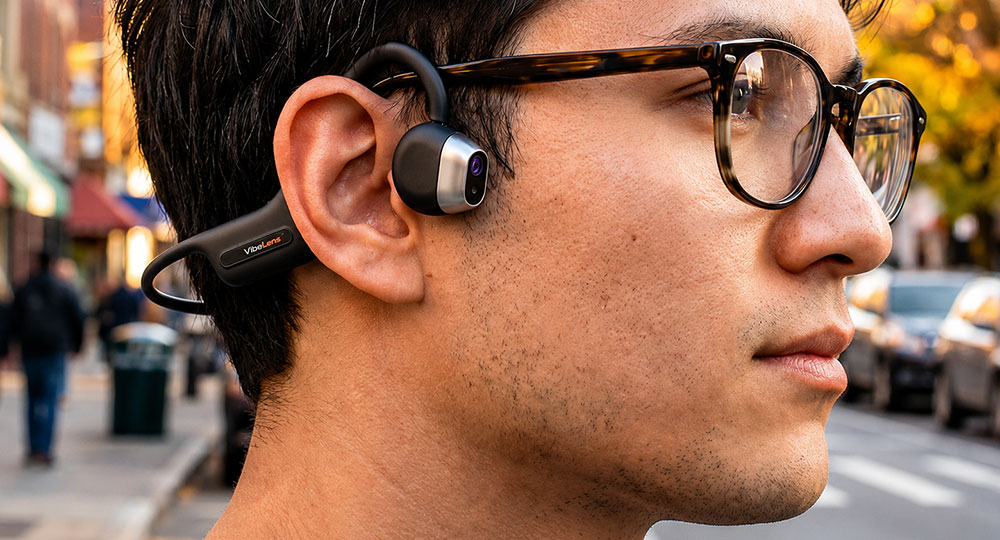
The VibeLens MusicCam combines a wearable camera with an open-ear wireless headset. (AI-generated image)
This device illustrates the kind of real-world wearable technology I discussed above. Rather than trying to replace a smartphone, the VibeLens MusicCam combines a point-of-view camera with an open-ear wireless headset. The result is a wearable that records hands-free video and functions as an everyday headset.
The open-ear design is another advantage. Unlike traditional in-ear earbuds, the headset leaves the ear canal unobstructed, allowing users to remain more aware of surrounding sounds — such as traffic or conversations — while listening to music or taking calls. That makes it well-suited for outdoor activities and other situations where maintaining awareness of one’s surroundings is important.
Another advantage is compatibility with prescription glasses or sunglasses. Because the VibeLens isn’t built into a pair of smart glasses, users can continue wearing the eyewear they already own rather than investing in a dedicated set of smart frames. It’s a practical example of wearable technology adapting to the user instead of requiring the user to adapt to the technology.
By combining hands-free video recording with an open-ear headset in a single device, the VibeLens MusicCam camera headset demonstrates how wearable technology can solve real-world problems without adding unnecessary complexity. That’s why it’s my Product of the Week.
Read the full article here