
Take a breath, close your eyes, and think about the words that define Seattle.
Innovative. Outdoorsy. Global. Inventive. Smart. Progressive. Independent. A little reserved. A little weird.
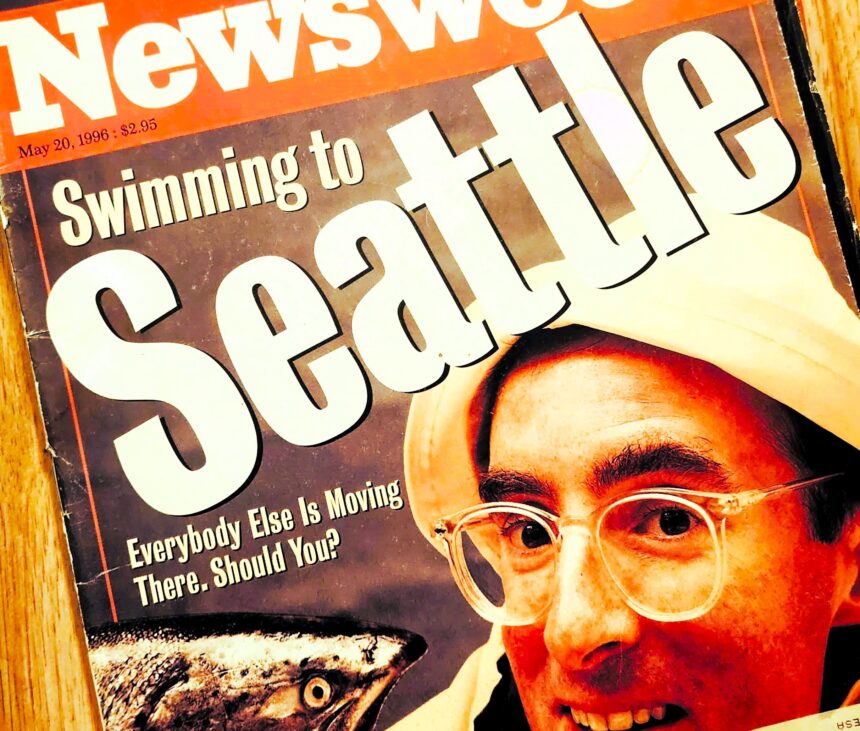
Thirty years ago today, Newsweek magazine published a cover story featuring political journalist Michael Kinsley titled: “Swimming to Seattle: Everybody Else Is Moving There. Should You?”
We wrote about the piece a few years ago in a different context, and it came to mind again today — eerily, on the exact anniversary of that story.
Back in May 1996, Seattle was emerging as one of America’s great boomtowns: grunge, coffee, software, airplanes, the web. A place with talent, ideas, ambition and room to grow.
It’s one of the reasons why I moved here 30 years ago, from a small town in Ohio.
Today, Seattle remains one of the world’s most important innovation hubs, home to global technology giants, leading AI research, world-class research and extraordinary entrepreneurial talent.
Which is exactly why the city’s shifting national image should concern us.
Because a new narrative about Seattle is taking hold nationally. And unlike the rain-slicker caricatures of the 1990s, this one isn’t charming.
The emerging narrative is this: Seattle has become increasingly ambivalent — even hostile — toward the very industries and innovators that helped build its prosperity.
Consider in the last month these headlines:
And it’s not just the national media. Seattle’s KOMO News reported this week on remarks by former Washington state governor Chris Gregoire, who pointed out a ballooning state budget since she left office in 2013.
“I would suggest to you, we don’t really have an income problem, we have a spending problem,” Gregoire said at a meeting hosted by the Association of Washington Business earlier this month.
You may disagree with those headlines. You may dislike the politics behind them. But rhetoric, image and storytelling matter — especially in a moment when cities are competing fiercely for talent, investment, startups and relevance in the AI era.
And right now, Seattle’s story is drifting in the wrong direction.
This week, the chairman of an iconic Seattle company — not operating in the tech industry — told me that the city’s increasingly anti-business image was complicating a national CEO search. Meanwhile, entrepreneurs and investors regularly tell us they feel vilified or unwanted.
We’ve spent more than 50 years importing some of the smartest people on the planet to this corner of the world — people working on things like cancer research, robotics, and yes AI — only to turn around and tell them not to let the door hit them on the way out.
Cities compete on psychology as much as policy. And our psychology is a bit shattered right now.
Six years ago, another national narrative engulfed Seattle during the Capitol Hill Autonomous Zone, or CHAZ — a protest occupation in Seattle’s Capitol Hill neighborhood that formed during the 2020 national reckoning over policing and racial justice.
Living here at the time, I thought much of the national media portrayal was exaggerated. I remember assuring friends and family back in Ohio that Seattle had not, in fact, descended into dystopian chaos despite what cable news suggested.
This moment feels different.
The concern now isn’t lawlessness or political theater. It’s civic drift. And right now, the national headlines resonate. They are telling a real story.
Seattle’s uncertainty about the very economic engine that transformed it into a global city is something that competitors are already beginning to notice.
Contrast Seattle with San Francisco, another progressive West Coast city wrestling with many of the same challenges. Its leaders are aggressively selling a comeback narrative centered on AI, entrepreneurship and reinvention.
Seattle, by comparison, is a city arguing with its own success.
San Francisco’s current narrative: A city on the rise.
Seattle’s current narrative: A city in demise.
Of course, there has always been a strain of “Lesser Seattle” thinking woven into Seattle’s culture — the instinct to resist growth, keep outsiders away and preserve an earlier version of the city before construction cranes and rapid change arrived.
That sentiment isn’t entirely irrational. Growth brought real costs: affordability challenges, displacement, congestion, inequality.
But it also brought extraordinary opportunities.
And in an era when artificial intelligence is reshaping industries, cities cannot afford to become complacent, confused about their identity, or dismissive of the people and companies driving innovation.
Seattle still has remarkable advantages. But advantages are not permanent.
Cities rise because they project confidence, ambition, and possibility. They decline when they begin treating success as something inevitable — or worse, something suspect.
Maybe that’s why another piece of Seattle culture has been stuck in my head lately: the absurdly catchy 1996 song “Peaches” by the Seattle rock band The Presidents of the United States of America: “I’m movin’ to the country, I’m gonna eat me a lot of peaches.”
The song captured a certain quirky, ironic version of Seattle at the tail end of the grunge era, a city that didn’t take itself too seriously.
Right now, though, Seattle faces a much more serious question: What kind of city does it actually want to become?
The choice seems clear. Move forward, progress, and tell a fresh story of hope in a city that’s still swimming in opportunity.
PREVIOUSLY: Are we on a Road to Nowhere? Seattle’s growth masks deeper anxieties about its future
Read the full article here