

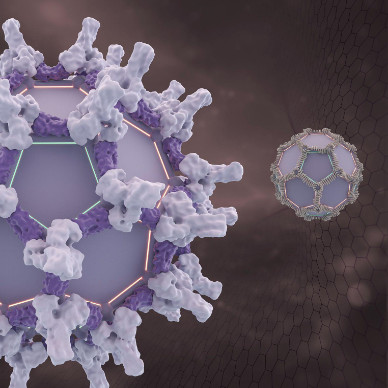
Medical experts use gene therapies for a variety of ailments — treating hemophilia with a clotting-factor gene or dosing a cancer patient with therapeutic DNA or RNA.
But doctors need a means of delivering that curative gene to a target in a patient’s body. Their solution has been harnessing viruses to shuttle the material, but the treatments are very expensive, limited in how much genetic material can be delivered and can trigger negative reactions.
Now researchers in the lab of Nobel laureate David Baker at the University of Washington’s Institute for Protein Design have created a way to build virus-like protein cages that could one day serve as delivery capsules for life-saving payloads.
Two strategies for engineering the protein cages are described in back-to-back papers published today in the journal Nature.
The discoveries open new possibilities for designing proteins from scratch, said Shunzhi Wang, a former Baker Lab postdoctoral scholar. He is now an assistant professor at New York University’s Grossman School of Medicine. Wang was a lead author on the papers, joined by Sangmin Lee, David Chemielewsk, Baker and others.
To visualize the new protein cages, imagine a soccer ball, which is built from pentagons and hexagons in a repeating pattern described as “quasisymmetry” because the subunits are identical but have different neighbors.

Scientists could previously make symmetrical protein cages from one or two types of building blocks, but that limited their overall size. During a casual Friday afternoon conversation, Wang, Lee and Baker hatched the idea of mixing building blocks by swapping partners from previous protein configurations.
“It was actually a serendipitous discovery,” Wang said.
The process didn’t go smoothly at first with proteins often assembling into globs. But by accounting for different geometric features and running many experiments, the scientists developed instructions that produced proteins with a curvature. As those curved proteins came together, they sensed a more crowded environment and responded by forming a mix of pentagons and hexagons to create a roomier configuration.
The resulting quasisymmetrical cages were two to three times larger than those formed by a single shape, bringing the scientists closer to the complex designs found in naturally occurring viral structures and making space for larger genetic payloads.
“These papers show that protein design is beginning to capture some of the architectural principles that nature uses to build at very large scales,” Baker said in a statement.
Additional studies are needed before the protein cages would be ready for human research and treatments. That includes tests of their immunogenicity — the immune response they might trigger if the body perceives them as dangerous invaders.
Farther down the line, Wang envisions the structures operating like a computer motherboard on which essential, modular components can be layered. In this case, that could include adding binding sites for directing the protein cage to a specific cellular target.
“That’s the beauty of this,” he said. “We can make tailored capsules for building and making more precise genetic medicines.”
The Nature papers are titled: “Design of one-component quasisymmetric protein nanocages” and “De novo design of quasisymmetric two-component protein cages.” Institutions leading the research were the IPD, NYU’s Langone Health, and South Korea’s Pohang University of Science and Technology. Collaborators included the Holt Lab at NYU’s Grossman School of Medicine, and the DiMaio and Veesler labs at the UW.
Read the full article here