

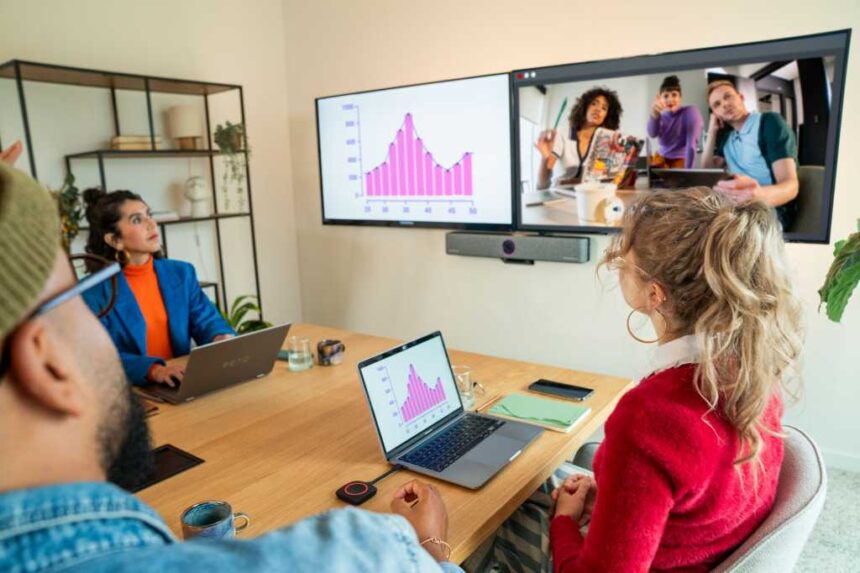
Hybrid work has reshaped how and where people collaborate. Offices are no longer the default destination for every interaction, yet they remain essential for moments that require focus, alignment, and human connection. In this reality, meeting rooms play a pivotal role, not because of the technology they contain, but because of how effortlessly people can use it.
The most successful hybrid workplaces share a simple truth: the best technology is the one that remains invisible in the room. When collaboration tools fade into the background, people can focus on ideas rather than interfaces. When they do not, friction quickly erodes adoption, productivity, and trust.
One experience across every space
Employees move between different meeting spaces throughout the day, from huddle rooms and project spaces to larger conference rooms. When each room comes with a different setup, interface, or connection flow, every meeting starts with uncertainty. Time is lost, confidence drops, and technology becomes a problem rather than an enabler.
Complexity is one of the main barriers to adoption in hybrid environments. Organizations struggle with underutilized rooms, inconsistent setups, and management overhead that grows with every additional configuration. The result is predictable: people avoid certain rooms altogether or fall back on ad-hoc workarounds.
A consistent, intuitive experience across all meeting spaces changes that dynamic. When users know exactly what to expect, regardless of room size or location, adoption increases naturally. Meetings start on time, collaboration flows more smoothly, and IT teams receive fewer support requests.
Technology as an enabler
The Flemish Government offers a powerful example of this principle in practice. In its Brussels hub, technology was deliberately positioned as an enabler for collaboration, not as a focal point. The goal was not to impress users with features, but to make connections effortless across more than a thousand meeting spaces.
By standardizing the collaboration experience with ClickShare solutions, employees could walk into any room and start collaborating and videoconferencing without instructions or training. This approach supported a people-driven hybrid workplace where flexibility and ease of use helped employees feel confident and connected, wherever they worked.
This emphasis on simplicity did more than improve user satisfaction. It removed friction at scale, allowing thousands of employees to collaborate in the same way, every time. Technology became something people relied on, rather than something they had to think about.
Higher adoption, lower IT burden
From an IT perspective, intuitive user experiences are not just a usability win. They are an operational advantage. Every extra step, cable, or configuration option increases the likelihood of errors and support tickets. Every exception to the standard creates additional management overhead.
Flexible, easy-to-deploy meeting room solutions reduce that burden. Organizations increasingly favor modular approaches that can be adapted to different spaces without introducing new user experiences or management models. This consistency simplifies deployment, monitoring, and updates, while giving IT teams greater control and predictability.
The outcome is a virtuous cycle. When users trust technology, they use it more. When they use it correctly, IT spends less time troubleshooting and more time optimizing. Adoption and manageability reinforce each other.
Designing for people, not just rooms
Ultimately, simplicity in the hybrid workplace is about designing for human behavior. People want to collaborate, share ideas, and move quickly between spaces. They do not want to learn new systems or adapt their workflows to the room they happen to be in.
Meeting room technology should respect that reality. By offering one intuitive experience across every space, organizations remove barriers to collaboration and create environments people want to use. As the Flemish Government experience demonstrates, when technology like ClickShare quietly supports collaboration instead of demanding attention, it becomes a true catalyst for hybrid work success.
In the end, the most advanced meeting room is not the one with the most features. It is the one people barely notice at all.
Discover hybrid collaboration with ClickShare
Read the full article here