
The science team behind the Vera C. Rubin Observatory has officially launched a decade-long survey of the southern sky — an ambitious project three decades in the making.
The start of the Legacy Survey of Space and Time, or LSST, follows years of planning and construction of the billion-dollar observatory in Chile. Scientists celebrated the completion of the construction phase with a “First Look” batch of pictures a year ago, and then turned to preparing for the LSST in earnest.
In February, the Rubin team turned on the observatory’s Alert Production Pipeline, which can send out millions of notifications about potentially noteworthy astronomical phenomena. That set the stage for what some have compared to filming a time-lapse movie of the cosmos.
“Today, we begin filming the greatest cosmic movie ever made. This moment reflects decades of vision, innovation and the power of federal investment in science through the U.S. National Science Foundation and the Department of Energy,” acting NSF Director Brian Stone said in a news release. “Every night, NSF-DOE Rubin Observatory will expand the frontiers of knowledge and strengthen America’s global leadership in science and innovation.”
Researchers at the University of Washington have played a key role in the project, primarily by developing software tools for analyzing the terabytes of data that the observatory is expected to produce on a nightly basis. That work is done at UW’s Institute for Data Intensive Research in Astrophysics and Cosmology, also known as the DiRAC Institute.
UW astronomer Zeljko Ivezić, who heads up the LSST campaign, helped determine when the observatory was ready for the survey.
“The decision to officially begin the LSST was made after a period of system optimization and a careful operational review of technical readiness, data system performance and scientific validation,” he said. Among the factors considered were image quality, effective survey speed, system reliability and calibration accuracy.
The observatory makes use of the world’s largest digital camera (3,200 megapixels per image) to capture a fresh picture every 40 seconds. If the skies over Chile are clear, the entire southern sky can be photographed over the course of just a few nights. Then Rubin begins the next round of picture-taking.
The concept for the observatory began with discussions among astronomers in the 1990s, and picked up steam in 2007 when Seattle-area tech pioneer Charles Simonyi and Microsoft co-founder Bill Gates contributed a total of $30 million to the project. In 2020, the observatory was named after the late astronomer Vera Rubin — and its 8.4-meter (27.5-foot) telescope was dubbed the Simonyi Survey Telescope in honor of Simonyi’s family.
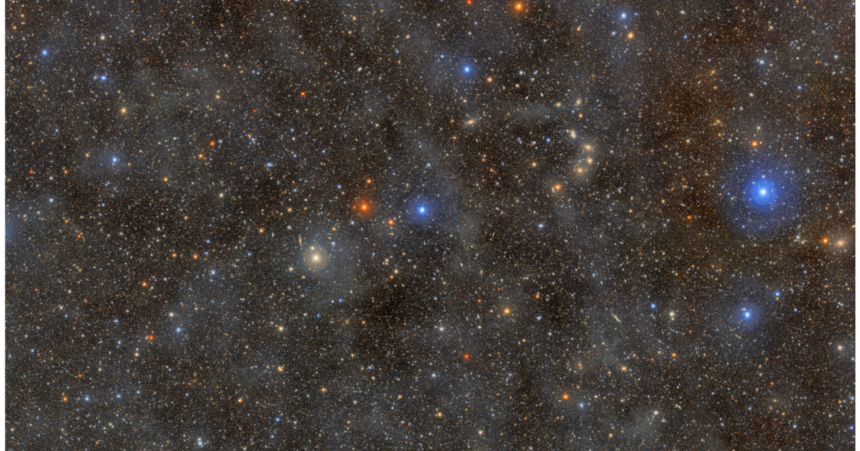
To celebrate the start of the survey, the Rubin Observatory team released a 1.7-gigapixel image featuring an “ocean of stars” in the constellation Lupus. “The faint, glowing clouds spread across this image are galactic cirrus: clouds of interstellar gas and dust that can be seen in the foreground of the Milky Way,” the team said in an image advisory.
Distant stars aren’t Rubin’s only targets. The survey is also expected to supercharge the search for small bodies in our own solar system. During preparations for the LSST, the Rubin team reported the discovery of more than 11,000 previously unseen asteroids. And that’s just the start: A computer simulation suggests that the survey could map more than 5 million asteroids.
Rubin’s observations could even shed light on the nature of dark matter and dark energy, invisible components of the cosmos that together make up more than 95 percent of the universe’s mass-energy content.
Scientists say the key to Rubin’s success will be the ability to track changes in the night sky over the course of 10 years.
“With its world-class design and tools, Rubin Observatory will capture the dynamic nature of our cosmos and reveal unimagined insights into our universe’s biggest mysteries, from our own solar system to the very structure of the universe,” said Dario Gil, undersecretary for science at the U.S. Department of Energy. “By seeking to understand the enigmatic phenomena of dark energy and dark matter, we are not just observing the stars; we are striving to grasp the fundamental laws that govern our existence.”
The Vera C. Rubin Observatory is a joint initiative of NSF and the U.S. Department of Energy’s Office of Science, and is operated jointly by NSF NOIRLab and SLAC National Accelerator Laboratory.
Read the full article here