
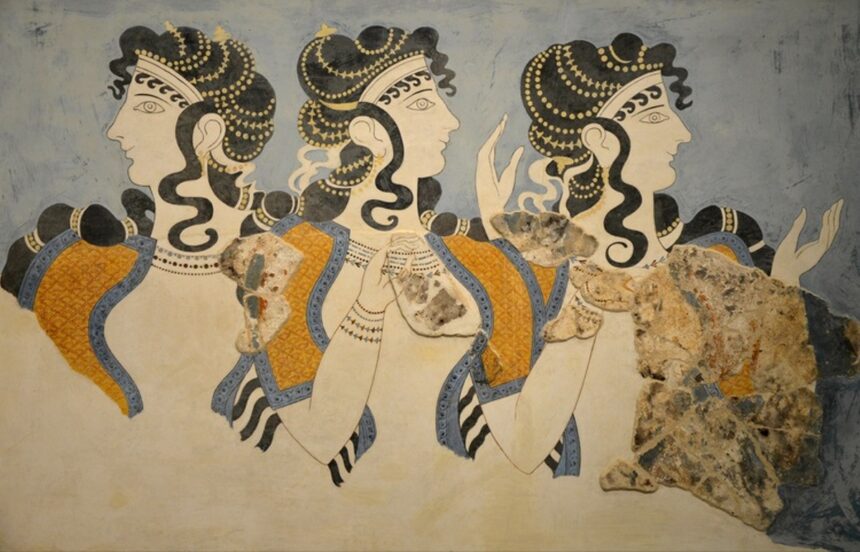
Long before Homer wrote the Odyssey, Minoan seafarers were plying the trade routes of the Mediterranean and spinning stories of adventure — but when it comes to imagination on an outlandish scale, the late science-fiction author Vonda N. McIntyre’s tale about a transoceanic Minoan odyssey just might have awed even Homer.
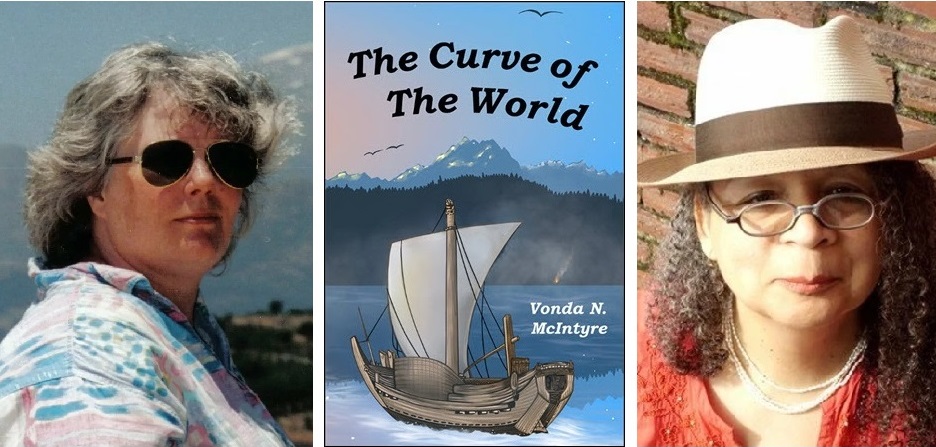
McIntyre finished the manuscript for her final book, “The Curve of the World,” less than two weeks before she died of pancreatic cancer in 2019. Since then, a team of writers and editors assembled by Clarion West — the Seattle-based literary nonprofit that McIntyre founded in 1971 — has been working to get the novel in shape for publication.
That work is now complete. The book has made its debut, and Clarion West is celebrating with a virtual book launch party on Saturday.
Nisi Shawl, an award-winning science-fiction and fantasy writer, admits to “fan-girling” during the editing process. “The sheer joy of the prose, the sensual array of delights that are offered, every bit of the way, the writing is just so pleasurable,” Shawl says in the latest episode of the Fiction Science podcast.
McIntyre was arguably best known for her novelizations of three “Star Trek” movies, plus two books based on the original TV series, a “Star Wars” novel and a totally original “Starfarers” book series. One of her award-winning novels, “The Moon and the Sun,” was adapted for a movie that was titled “The King’s Daughter” and released after her death.
“The Moon and the Sun” blended history, fantasy, science fiction and romance in an alternate-universe version of 17th-century France under the reign of Louis XIV. “The Curve of the World” follows a similar trajectory — but set in the Bronze Age, about 3,600 years ago.
In a sense, the tale is complementary to Homer’s Odyssey, which is getting the Hollywood treatment this summer in a movie starring Matt Damon as Odysseus. “It’s a side-by-side emergence of a literal hero’s journey and a literal heroine’s journey,” Shawl says.
McIntyre’s main character is a woman, not a man. She’s a diplomat, not a warrior. And her odyssey is the reverse of Odysseus’ homeward voyage. The long and winding trip begins at home, on the island of Crete, and goes far beyond the Mediterranean Sea to the Americas.
Along the way, the Minoan crew encounters Nordic pirates on the high seas, hunter-gatherers on North America’s Atlantic Coast and a bloodthirsty society in ancient Mesoamerica that keeps its mummified ruler around long after death. Perhaps the most outlandish stretch in McIntyre’s tale has the crew crossing over to the Pacific side of the Americas and sailing up to, of all places, Puget Sound.
The Minoans encounter a strange new world where the inhabitants live in longhouses, weave the fur of woolly dogs into their blankets, and feast on cedar-planked salmon. But it’s no utopia: The visitors become entangled in intertribal conflicts as well as natural threats that are all too familiar to the Pacific Northwest’s modern-day residents.
Although the Minoans were skilled travelers and traders, they weren’t as skilled as they’re portrayed to be in McIntyre’s novel. “While I’d love to believe some intrepid Minoans crossed the Pacific using the stars, unfortunately the archaeological evidence for anything beyond the Mediterranean remains extremely limited,” Alessandro Berio, a Brazilian archaeoastronomer who has studied the Minoans extensively, said in an email.
“The Minoans, generally considered Europe’s first advanced maritime civilization, established the earliest large-scale trade network in the Mediterranean. Archaeological material has been recovered throughout Egypt, the Levant and Anatolia,” Berio said. But he added that clear evidence for Mediterranean navigators venturing beyond the Mediterranean itself “only appears later, during the Phoenician period.”
That’s the difference between the sort of history that Berio studies and the fiction-flavored history that was McIntyre’s specialty. Shawl is a practitioner of that type of history as well: Shawl’s best-known novel, “Everfair,” describes a steampunk world in which socialists and missionaries unite to foster an independent nation in the Belgian Congo at the dawn of the 20th century.
“I’m starting to come to the conclusion that ‘alternate history’ is probably a misnomer, because sometimes it’s sort of like a veering away from the history we know, right?” Shawl says. “Sometimes it’s a hidden history, something that happened within the interstices of the history that we know. And sometimes it’s just straight-up a different version, a different perspective.”
McIntyre was known for highlighting different perspectives when it came to gender and sexual diversity. There’s plenty of that in “The Curve of the World.” For example, one of the characters smoothly switches between acting as a man or a woman, depending on the circumstance.
Shawl found the novel’s main character, a trader and emissary named Iakinthu, to have a particularly interesting perspective on the cultures she encounters. “She was not being, like, traditionally aggressive, but she was not giving way, either,” Shawl says. “She was very much, ‘You got to do you, but when it comes to our interactions, you do me.’ I really want to study how Vonda portrayed her doing that, because I think it will be helpful in modern times.”
In the book’s acknowledgments, McIntyre provided a cautionary note about real Minoan history vs. her alternate “Idaean” history: “Do not try to match the Idaean timeline to ours because your head will explode,” she wrote.
“My head did explode,” Shawl admits. “My head exploded because I was trying to hold together all the different layers of reality that she was carving up and serving. Other people have told me of earlier incidents where they were like, ‘Is this how it really could have happened? Is this what did happen? What is Vonda doing?’
“Well, she’s just being great, that’s all,” Shawl said.
Clarion West is presenting a virtual book launch party for “The Curve of the World” at 11 a.m. PT Saturday. Follow the link from this webpage to RSVP and get the Zoom link for the event. Shawl and two other book editors — Debbie Notkin and L. Timmel Duchamp — will read from the book and discuss the project. Kath Wilham also participated in the editing process.
Clarion West is also presenting a “Curve of the World” reading and conversation with Shawl and Theo Downes-Le Guin — the literary executor for author Ursula K. Le Guin’s estate — at Elliott Bay Book Company in Seattle at 7 p.m. PT on July 16. Follow the link from this webpage to RSVP and get in-person or virtual tickets.
My co-host for the Fiction Science podcast is Dominica Phetteplace, an award-winning writer who is a graduate of the Clarion West Writers Workshop and lives in San Francisco. To learn more about Phetteplace, visit her website, DominicaPhetteplace.com.
Fiction Science is included in FeedSpot’s 100 Best Sci-Fi Podcasts. Check out the original version of this report on Cosmic Log to get sci-fi reading recommendations from Shawl, and stay tuned for future episodes of the Fiction Science podcast via Apple, Spotify, Player.fm, Pocket Casts and Podchaser. If you like Fiction Science, please rate the podcast and subscribe to get alerts for future episodes.
Read the full article here